
Blue Dial vs Black Dial: Which One Is Actually Easier to Wear Every Day?
Blue Dial vs Black Dial: Which One Is Actually Easier to Wear Every Day?
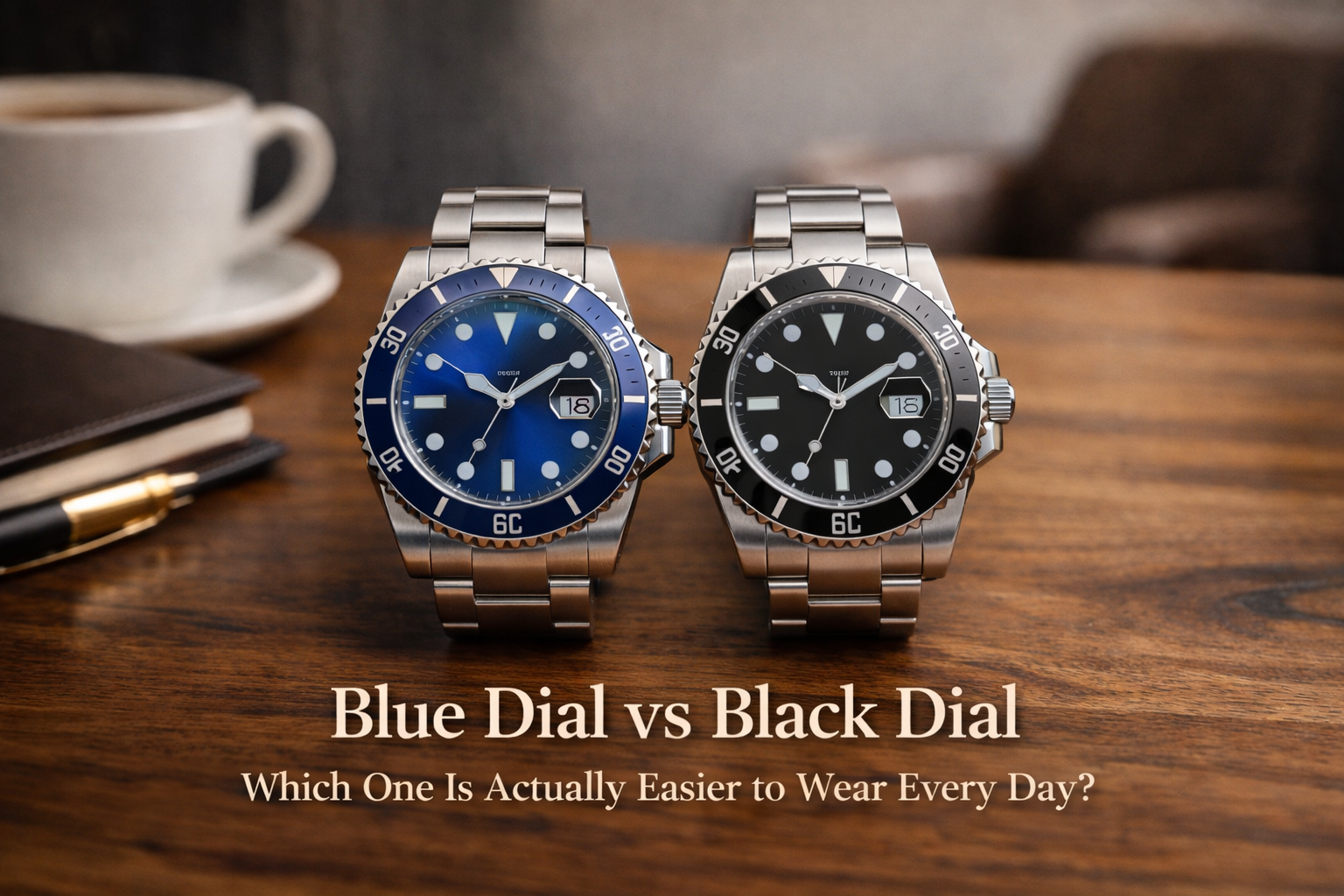
A lot of people think choosing between a blue dial and a black dial should be easy.
Black seems safer.
Blue seems more interesting.
Black feels more classic.
Blue feels a little more personal.
But once you actually start wearing watches in real life, the choice becomes less obvious than people expect.
A dial color is not just a color. It changes how the watch behaves with clothes, how it reacts to light, how formal or casual it feels, how noticeable it looks from across a table, and even how often you still want to wear it after the first few weeks.
That is why this question matters more than it sounds:
If you want one watch that feels easy to wear every day, is a blue dial or a black dial actually the better choice?
This is not really about which color is prettier in a product photo. It is about what happens when the watch becomes part of your real routine — office days, commuting, café stops, shirts, jackets, summer light, travel, weekends, and long-term wear.
If you have already read our article on does a black dial watch really go with everything or our guide on what makes one black dial watch look more premium than another, you already know that dial color affects much more than appearance. It affects whether a watch keeps feeling easy after the excitement of the first impression is gone.
Quick Answer
For most people, a black dial is still the easier everyday choice because it usually feels more neutral, more flexible with clothing, and more stable across office, casual, and formal situations. But a blue dial can feel better for daily wear if you want a little more character without going too loud, especially when the shade of blue is dark, controlled, and easy to read. Black usually wins on pure versatility. Blue often wins on personality.
Why This Comparison Is More Important Than It Looks
People often choose dial color too quickly.
They see a watch online, like the blue version because it looks more special, and assume that means it will also feel better over time. Or they go straight to black because it feels safer, without thinking about whether “safe” will turn into “a little too predictable” after a while.
The truth is that blue dial vs black dial is one of the most practical watch choices a buyer can make, because it affects:
- daily outfit matching
- office friendliness
- light response
- perceived elegance
- how noticeable the watch feels
- long-term wear satisfaction
This is especially important if you are choosing one main watch instead of several.
If you only want one piece to cover most situations, dial color becomes much more than a cosmetic choice. It becomes part of how often the watch actually gets worn.
1. Black Usually Feels Easier Because It Creates Less Friction
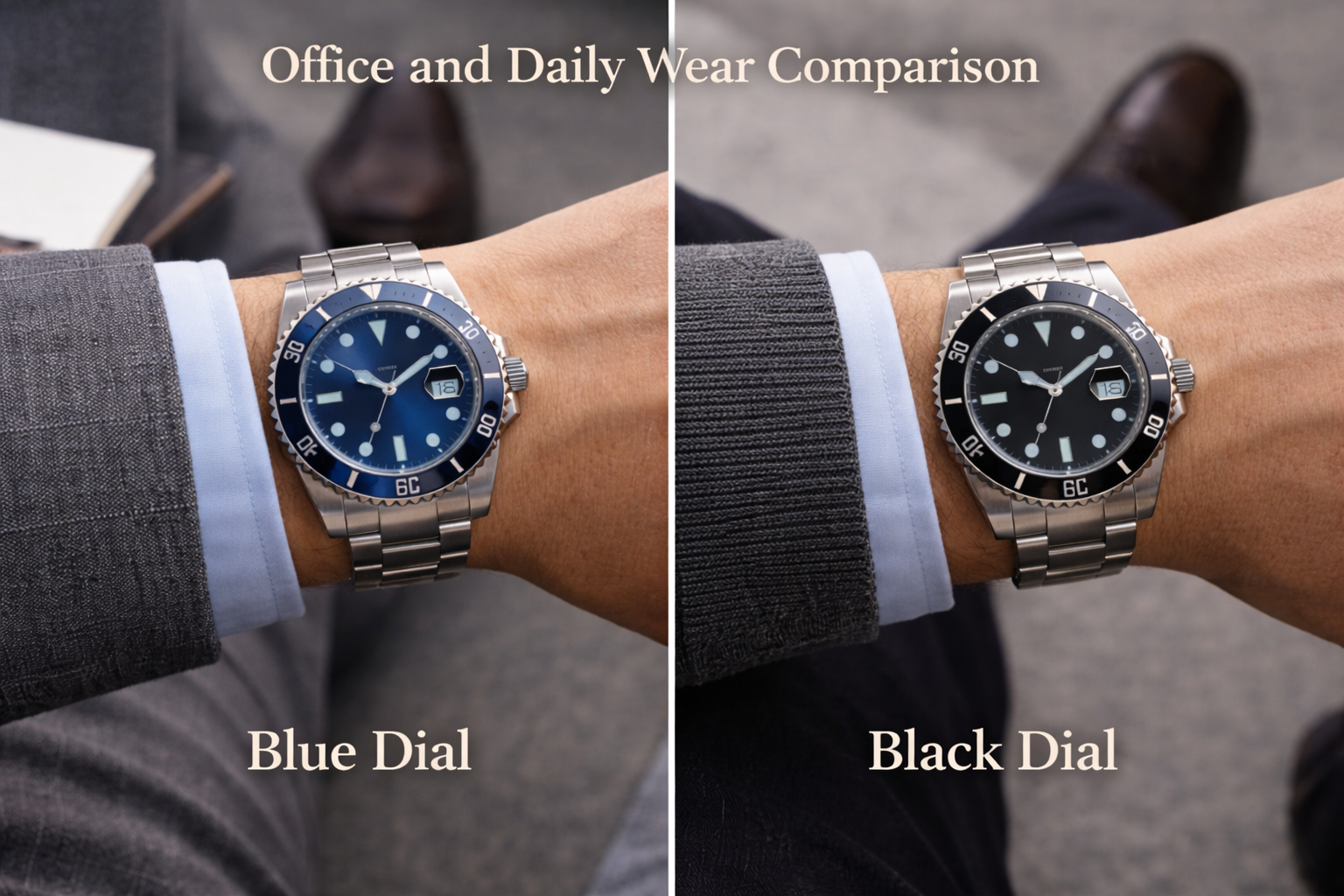
If we are speaking purely in practical terms, black usually wins.
The biggest reason is simple: black creates less friction.
A black dial tends to feel easier because it usually works with more things without asking for special attention. It often feels natural with:
- office shirts
- sweaters
- blazers
- casual jackets
- neutral travel outfits
- black or brown shoes
- formal clothing
- everyday casual wear
That matters more than people think. A lot of “easy daily watches” are not exciting because of the dial color. They are easy because they do not force you to think too much.
A black dial often disappears into the watch in the best possible way. It lets the case, markers, bracelet, and shape do their job without creating too much extra personality.
That is why black still feels like the default answer for many buyers. Not because it is boring, but because it usually causes the fewest problems.
2. Blue Often Feels Better When You Want a Watch With More Life
Now the other side.
Blue is often the better choice when you want the watch to feel just a little more alive without becoming difficult to wear.
This is where blue dials become interesting. They often give you something black does not:
- more visual depth
- more personality
- more variation in light
- a less severe feeling
- a dial that can feel richer and more expressive
That is why many people fall for blue the first time they see it in person. A good blue dial often has more movement and more warmth than black, especially under natural light.
In real life, a strong blue dial can feel:
- more modern
- slightly more relaxed
- more eye-catching without being loud
- more distinctive than black
- easier to enjoy emotionally over time
So while black may be more practical, blue often feels more emotionally satisfying.
That is a real trade-off, and it is one reason this choice keeps coming up.
3. In Office Wear, Black Usually Feels Safer
For office use, black usually has the edge.
This does not mean blue is bad in the office. A dark, controlled blue can work very well. But black tends to feel safer because it blends into workwear more naturally and usually looks more restrained in indoor lighting.
A black dial often works especially well with:
- white shirts
- blue shirts
- grey tailoring
- navy jackets
- knit polos
- quiet business-casual outfits
It usually feels clean, serious, and easy to trust.
A blue dial can still look excellent in an office, but it changes depending on the shade:
- a dark navy blue may look refined and versatile
- a bright sunburst blue may feel more expressive
- a lighter or more vivid blue may start looking less formal
That is why black often wins when someone wants a watch that never feels wrong at work.
If the goal is “I want one watch that I never need to second-guess before leaving the house,” black has a real advantage.
4. In Casual Wear, Blue Often Feels More Relaxed and More Interesting
Once you leave the office environment, blue starts becoming more attractive.
In casual settings, black can sometimes feel slightly too neutral or too expected, especially if the watch itself is otherwise simple. Blue often adds just enough color to make the watch feel more enjoyable.
This shows up in situations like:
- weekend coffee runs
- casual dinners
- travel outfits
- jeans and overshirts
- knitwear and jackets
- lighter spring and summer clothing
A blue dial often feels more expressive without needing a dramatic design. It can make an otherwise simple watch feel more like a choice, rather than a default.
This is where many buyers start preferring blue. They realize that black is easier, but blue is sometimes more fun to live with.
And for daily wear, emotional pull matters. If a watch looks slightly more alive every time you glance at it, that can be enough to make it the one you keep reaching for.
5. Black Usually Looks More Formal, Blue Usually Looks More Adaptable to Mood
This is one of the most useful real-life distinctions.
Black often feels:
- more formal
- more direct
- more neutral
- more stable
- more traditionally versatile
Blue often feels:
- more atmospheric
- more expressive
- more style-driven
- more modern in some settings
- more dependent on the exact shade and light
That is why black often wins in “objective versatility,” while blue can win in “subjective enjoyment.”
If your wardrobe leans formal, minimal, or business-oriented, black may stay easier.
If your wardrobe leans smart-casual, textured, or a bit more relaxed, blue may feel more natural than expected.
So the better everyday choice depends partly on how you actually dress, not just on the watch.
6. Light Changes Blue More Than Black
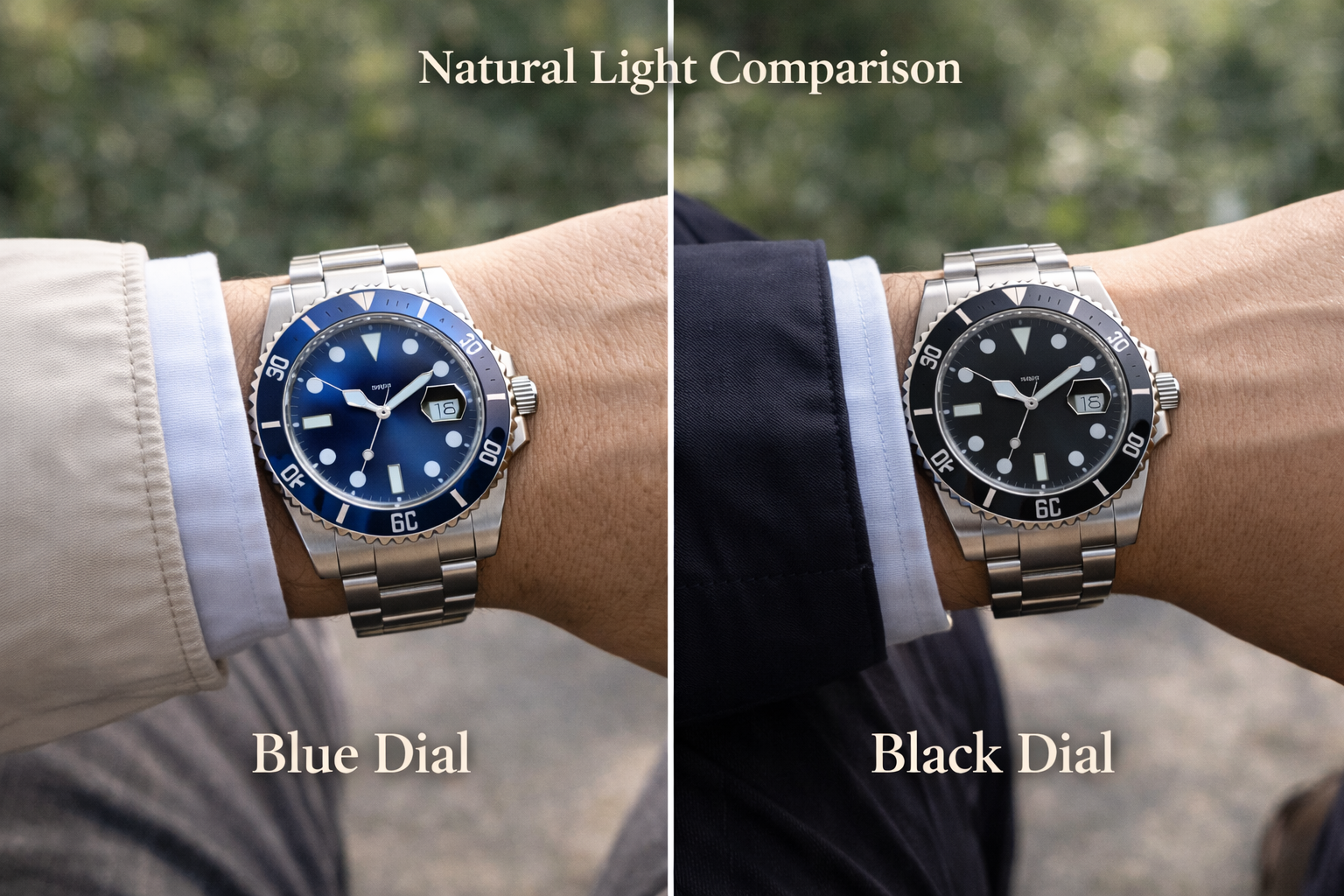
This is a huge part of the decision.
Black tends to stay more consistent.
Blue tends to change more.
That can be a strength or a weakness.
A black dial usually behaves more predictably in:
- office light
- low indoor light
- shade
- direct sunlight
- evening wear
A blue dial often shifts more dramatically depending on environment:
- under sunlight it may come alive beautifully
- near a window it may show more depth
- in darker rooms it may look almost black
- under artificial lighting it may become brighter, flatter, or more reflective depending on the finish
This is why blue can feel more interesting but also slightly less stable. Some people love that. Others find it makes the watch feel less universal.
If you want one dial that looks more or less reliable in every condition, black is easier.
If you want a dial that rewards light and changes mood, blue is stronger.
7. Black Usually Wins If You Care About “Never Looking Wrong”
There is a certain kind of buyer who does not want the watch to be the interesting part of the outfit.
They want it to feel right.
Quiet.
Balanced.
Easy.
For that buyer, black usually wins.
A black dial is hard to make look completely out of place. It may not always feel the most exciting, but it rarely feels inappropriate. That is a very strong quality in a daily watch.
This is also why black is so often chosen for:
- first good watch purchases
- one-watch collections
- work-heavy lifestyles
- more conservative wardrobes
- people who value ease over variety
If you are the type who would rather never second-guess your watch choice, black remains one of the safest and smartest daily dial colors.
8. Blue Usually Wins If You Want “Safe, But Not Too Safe”
There is also another kind of buyer.
They do want versatility.
But they do not want the watch to feel too standard.
They want something that still works daily, but feels a bit more personal.
That is where blue shines.
A good dark blue dial often gives you the best part of black’s wearability, but with a little more personality. It can feel:
- less generic
- more elegant in daylight
- more memorable
- more satisfying to look at over time
This is especially true if the watch design itself is clean and the blue is controlled rather than loud.
In other words, blue often works best when you want:
an everyday watch that still feels like a choice.
That is a strong position, and it is why blue dials have become so popular.
9. Which One Looks More Expensive?
This depends on the setting.
A black dial often looks more expensive in a very immediate way because it feels controlled, serious, and visually clean. It usually gives a stronger first impression in office, formal, and low-light environments.
A blue dial can also look very expensive, but often in a slower, more layered way. It may feel richer in daylight and more visually interesting up close.
In many situations:
- black looks more expensive at first glance
- blue looks more special after a longer look
This is similar to what we discussed in what makes one black dial watch look more premium than another. The answer is not just the color. It is how the dial, light, finishing, and overall watch design come together.
So if the question is “Which dial color gives the easiest premium impression?” black usually has the edge.
If the question is “Which dial color can feel more emotionally rich?” blue may win.
10. Which One Is Better for Travel?
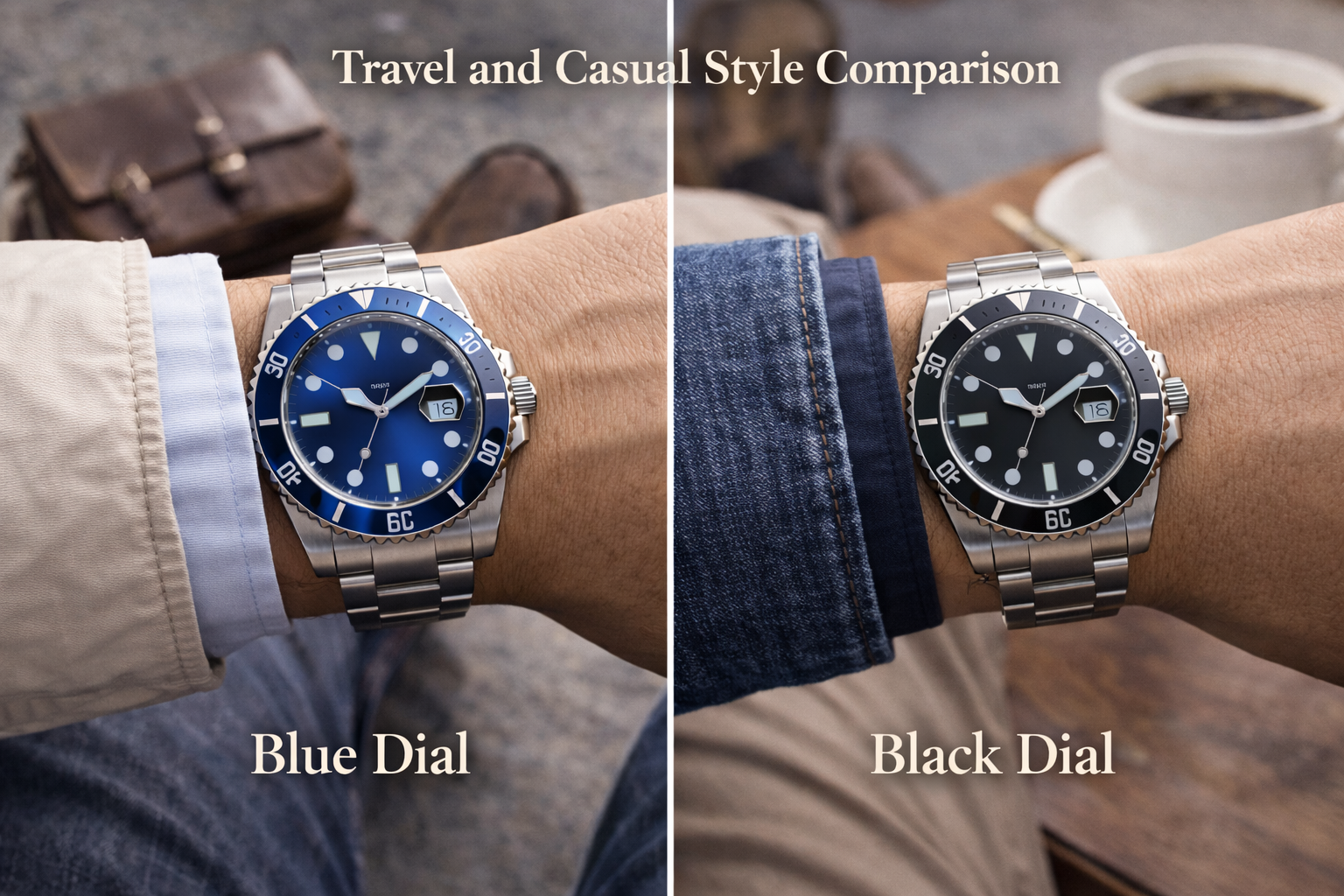
Travel is one of the best real-world tests for a daily watch.
You want a watch that can move between:
- airport clothing
- daytime walking
- dinners
- photos
- different shoes and outfits
- changing weather and lighting
Here, black often wins on simplicity. It just travels easily.
But blue can be very good too, especially if:
- the watch is your main personal piece
- you want a little more variety in photos and daylight
- your clothing is mostly neutral and lets the dial be the accent
So the answer depends on what kind of traveler you are.
If you want the easiest “throw it on and go” option, black is usually better.
If you want the watch to bring more personality to your trip, blue may be more satisfying.
11. So Which One Is Actually Easier to Wear Every Day?
If we are being strict and practical, the answer is still:
Black.
Black is easier because it usually:
- matches more outfits
- feels more stable in more settings
- reads more neutral
- works better in formal and office situations
- creates less visual friction overall
But that is not the whole story.
Because if your idea of “easy to wear” also includes enjoyment, personality, and wanting to keep reaching for the watch, then blue can absolutely become the better everyday choice.
So the honest answer is:
- Black is easier in a universal sense
- Blue is easier if it fits your style and gives you more long-term enjoyment
That is the real distinction.
What Buyers Usually Get Wrong
A lot of people think this choice is about versatility versus style, but that is too simple.
They assume:
- black is always boring
- blue is always harder to wear
- black is always more formal
- blue is always more casual
- darker blue and black behave completely differently
In real life, a dark blue dial can be much easier than people expect, and a black dial can be much richer than people give it credit for.
The real question is not “Which color is better?”
It is:
Which kind of daily wear do I actually want?
Do you want ease with almost everything?
Or do you want a little extra feeling every time you look down at your wrist?
How to Judge This More Realistically
If you are deciding between blue and black for an everyday watch, ask yourself these questions:
1. What do I wear most often?
Office clothing, casual clothing, travel wear, tailoring, knitwear.
2. Do I want the watch to disappear into the outfit or add a little personality?
Black usually disappears more easily. Blue often adds more character.
3. Am I buying one main watch or several?
If it is one main watch, black is often safer. If you already have a neutral watch, blue can make more sense.
4. Which one still looks right in different lighting?
This matters more than product photos suggest.
5. Which one would I still want to wear after the novelty wears off?
That is usually the most honest question of all.
This is also why how to choose the right watch for everyday wear is never just about size or brand. The dial color changes the wearing experience much more than many buyers expect.
Final Thoughts
If you want the simplest, safest, easiest daily answer, black dial still wins.
It is more neutral, more stable, more office-friendly, and usually easier to wear across the widest range of situations. That is why it remains such a strong default.
But a blue dial can absolutely be the better everyday choice if you want something with a little more life, depth, and personality — especially when the blue is dark, controlled, and easy to read.
So black is usually the safer everyday answer.
Blue is often the more satisfying one.
And the best choice depends on whether you want your daily watch to feel more effortless, or a little more alive.
FAQ
Is a blue dial harder to wear every day than a black dial?
Usually yes, but not by a huge amount. A dark blue dial can still be very wearable, though black remains the easier universal choice.
Which dial color is better for office wear?
Black is usually better for office wear because it feels more neutral, more serious, and easier to pair with formal or business-casual clothing.
Does a blue dial look more expensive than a black dial?
Sometimes in daylight, yes. But black often gives the easier premium impression in everyday and formal settings.
Which one should I choose if I only want one watch?
If you want one watch for the widest range of situations, black is usually the safer answer.
Is a black dial too boring for daily wear?
Not necessarily. A well-made black dial can feel clean, premium, and very satisfying over time, especially if the finishing and dial texture are strong.
