
Quartz vs Automatic Accuracy: Which Watch Keeps Better Time?
Quartz vs Automatic Accuracy: Which Watch Keeps Better Time?
Quick Answer
If accuracy is your top priority, quartz watches are more accurate than automatic watches in normal daily use. A quartz watch usually loses or gains much less time over a month, while an automatic watch is generally less precise because it relies on mechanical movement rather than a battery-powered quartz regulator.
In simple terms:
Quartz is better for accuracy. Automatic is better for mechanical character and traditional watch appeal.
Why Accuracy Matters to Watch Buyers
Accuracy is one of the first things many people care about when choosing a watch. Even buyers who love style, craftsmanship, or brand heritage still want to know one basic thing:
Will this watch actually keep good time?
That question matters even more when choosing between quartz and automatic watches, because these two types work in completely different ways. One is built around practical precision. The other is built around mechanical movement and traditional horology.
If you are still comparing the basics of quartz and mechanical ownership, our guide on mechanical vs quartz watches is a useful place to start.
What Does Watch Accuracy Mean?
Watch accuracy simply refers to how close a watch stays to the correct time over a period of use.
A watch is never judged by whether it is perfect every second forever. Instead, people usually talk about how much it gains or loses over time, such as:
-
seconds per day
-
seconds per week
-
seconds per month
This is why one watch may be considered very accurate even if it is not mathematically perfect.
Why Quartz Watches Are Usually More Accurate
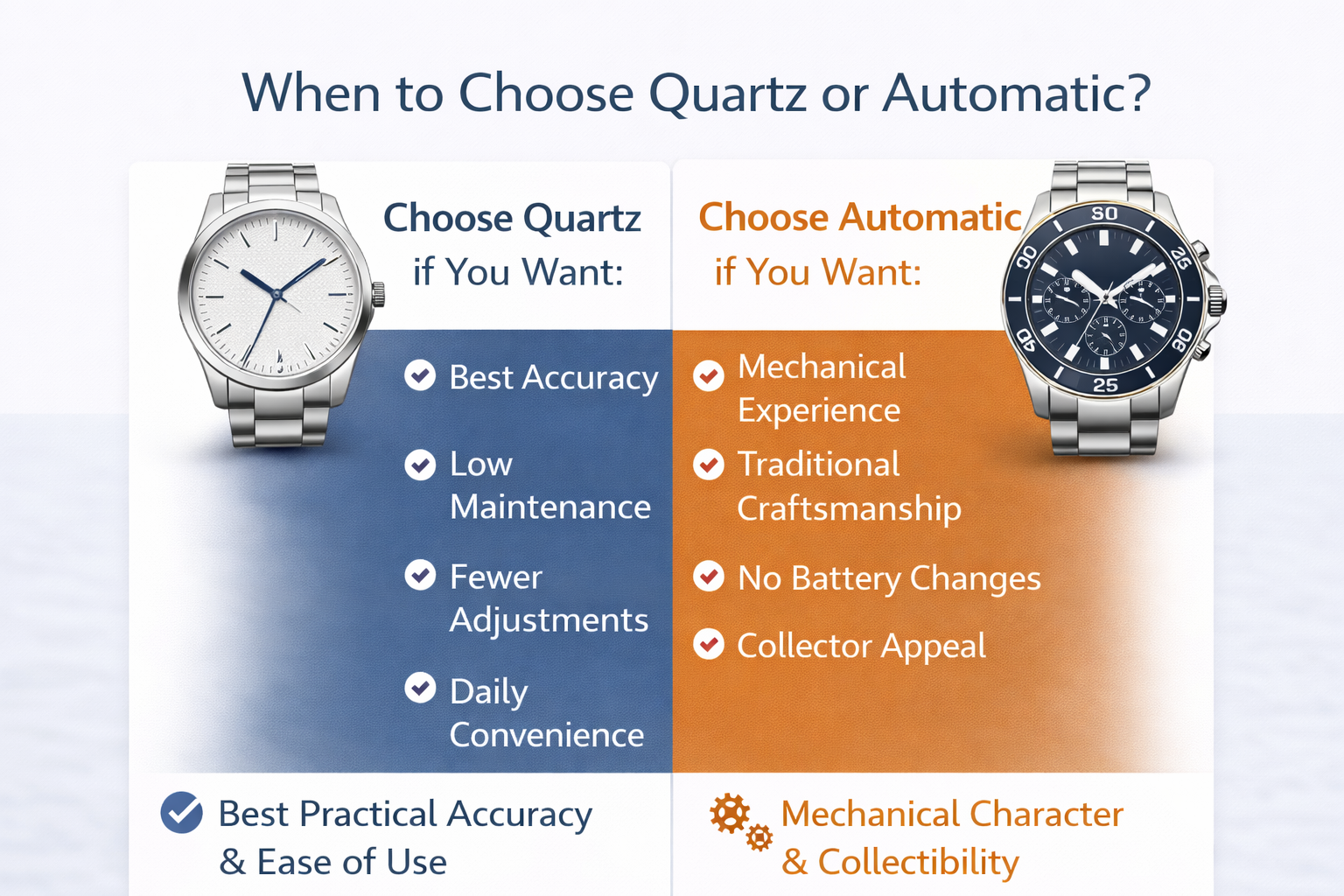
Quartz watches are usually more accurate because they regulate time using a battery-powered quartz oscillator, which vibrates at a highly stable frequency.
That stability is the main reason quartz became known for reliable timekeeping. In everyday use, a standard quartz watch usually drifts much less than a typical automatic watch.
What This Means in Real Life
A normal quartz watch may only be off by a small amount over a full month, while an automatic watch may drift noticeably more over just a few days.
For people who want a watch they can pick up and trust without much adjustment, quartz has a clear advantage.
If low-maintenance ownership matters to you, our article on how long a watch battery lasts can help you understand the practical tradeoff behind quartz convenience.
Why Automatic Watches Are Usually Less Accurate
Automatic watches use a mechanical movement powered by a mainspring and regulated by a balance wheel. This is a much more traditional system, but it is also more sensitive to:
-
position
-
gravity
-
movement variation
-
wear
-
lubrication condition
-
shock
-
temperature
Because of that, automatic watches usually do not keep time as precisely as quartz watches in normal daily life.
Does That Make Automatic Watches Bad?
No. It just means they are designed around a different kind of value.
People choose automatic watches for reasons like:
-
mechanical craftsmanship
-
traditional watchmaking appeal
-
smoother ownership experience without batteries
-
collector interest
-
emotional connection to how the movement works
So automatic watches are not “worse” in every sense. They are simply not the best choice if pure accuracy is your main priority.
Quartz vs Automatic Accuracy in Daily Use
Here is the most practical comparison.
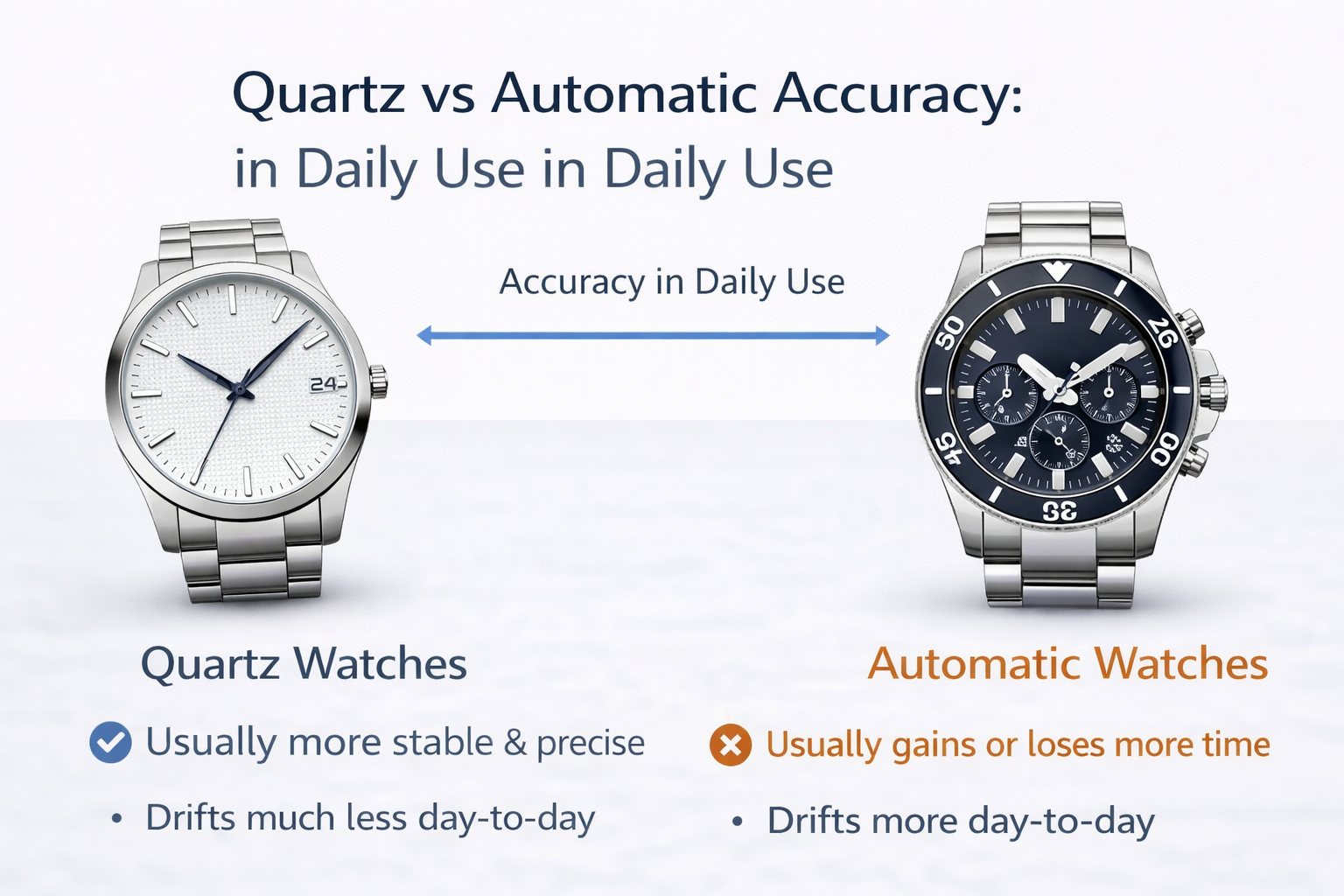
Quartz Watch Accuracy
A standard quartz watch is usually much more stable in daily timekeeping. For many people, it can go weeks or even months with only small deviation.
Automatic Watch Accuracy
An automatic watch usually gains or loses more time day to day, and this can vary depending on:
-
how consistently you wear it
-
how active you are
-
how the watch is regulated
-
the quality of the movement
This means that in direct real-world use, quartz is usually the better choice for accuracy.
Which One Keeps Better Time Over a Week?
Over a week, quartz almost always keeps better time.
A quartz watch may stay close enough to the correct time that many people barely notice any drift. An automatic watch, even a decent one, may be noticeably fast or slow by the end of the week depending on how it is regulated.
For someone who checks time often and wants precision, this difference is easy to notice.
Which One Keeps Better Time Over a Month?
Over a month, the difference usually becomes even more obvious.
A quartz watch may still be very close to the correct time. An automatic watch may need a reset or adjustment depending on how much it has gained or lost.
This is one reason people who want pure convenience often prefer quartz, especially for daily wear.
If your goal is easy everyday use, our guide on how to choose the right watch for everyday wear may help you decide what matters most beyond movement type.
What Affects Automatic Watch Accuracy?
Automatic watch accuracy depends on more than just whether the watch is expensive.
Important factors include:
-
movement quality
-
factory regulation
-
servicing condition
-
how fully wound the watch is
-
how often you wear it
-
resting position overnight
This is why two automatic watches can feel very different in actual ownership.
A well-regulated automatic can perform very well, but it still usually will not match quartz for pure accuracy.
If long-term performance matters to you, it is also worth reading why watch servicing matters.
Can an Automatic Watch Be Accurate Enough?
Yes, absolutely.
This is an important point.
Automatic watches are usually less accurate than quartz watches, but that does not mean they are inaccurate in a useless way.
For many people, an automatic watch is still accurate enough for normal daily life. If you are comfortable adjusting it occasionally, it may feel completely fine in practice.
So the better question is not:
“Is automatic perfectly accurate?”
It is:
“Is automatic accurate enough for the way I live?”
For many buyers, the answer is yes.
Why Some People Still Prefer Automatic Watches
If quartz is more accurate, why do so many people still buy automatic watches?
Because accuracy is only one part of watch ownership.
People often prefer automatic watches because they like:
-
the craftsmanship
-
the movement without batteries
-
the tradition
-
the feeling of wearing something mechanical
-
the emotional value of the watch
This is especially true for enthusiasts who care about the watch itself, not just the timekeeping performance.
If you are choosing your first watch and want to balance practicality and enjoyment, our guide on best watch types for beginners can help.
When Quartz Is the Better Choice
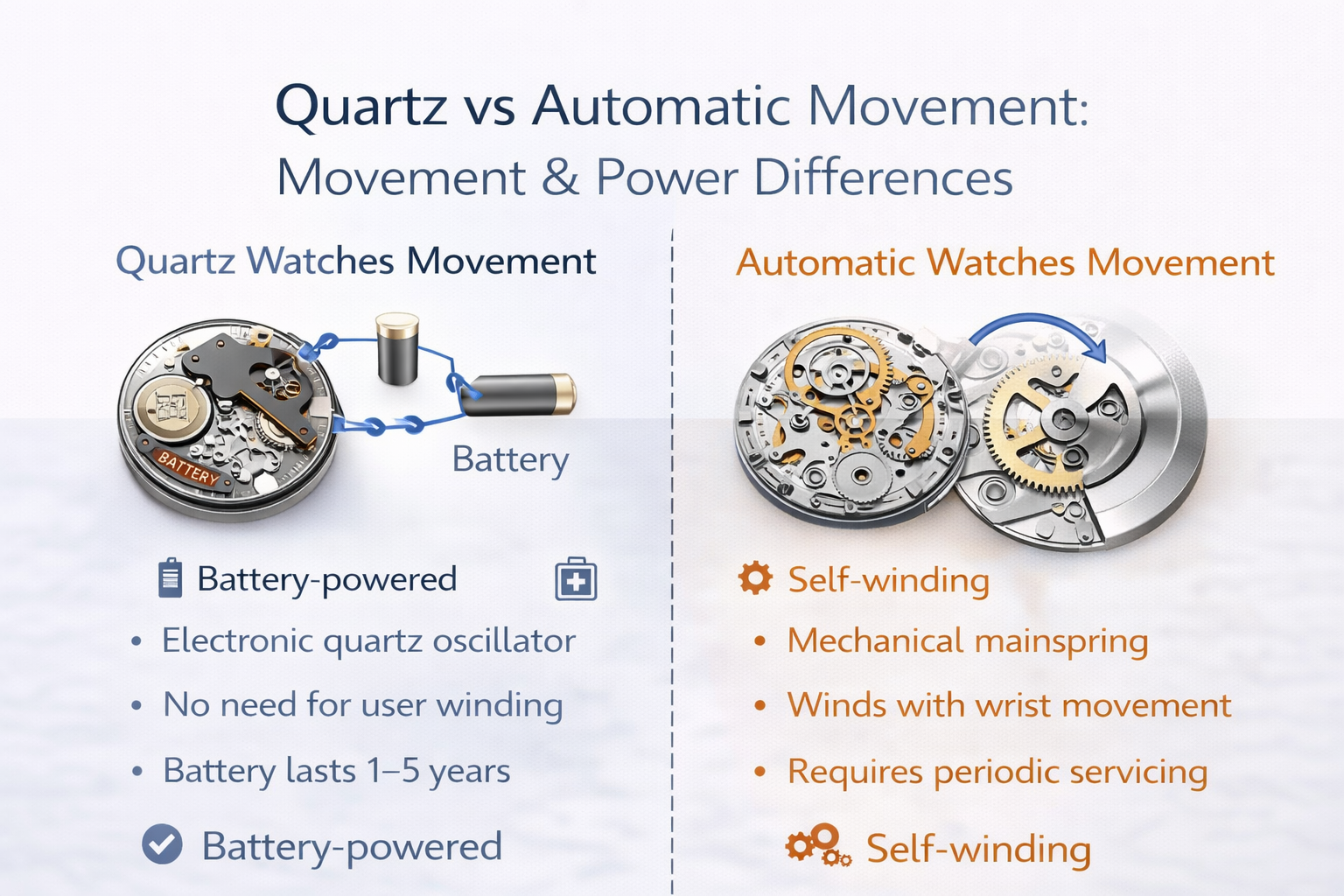
Quartz is the better choice if you want:
-
the best practical accuracy
-
low-maintenance ownership
-
a watch that is easy to grab and wear
-
fewer time adjustments
-
daily convenience
For many people, that makes quartz the smartest real-world option.
When Automatic Is the Better Choice
Automatic is the better choice if you want:
-
a mechanical watch experience
-
traditional craftsmanship
-
collector appeal
-
no battery changes
-
a stronger emotional connection to the movement
Automatic may be less accurate, but it often offers something quartz does not: character.
Common Mistakes Buyers Make
One common mistake is assuming less accurate automatically means worse overall. That is not true. It only means worse in one category: precision.
Another mistake is buying an automatic watch while expecting quartz-like convenience. That often leads to disappointment, because the ownership style is different.
Some buyers also go the other way and dismiss quartz too quickly, even though quartz may be the better watch for their real life.
The smartest choice is to decide whether you care more about precision or mechanical appeal.
Which Is Better Overall?
That depends on what “better” means to you.
If better means accuracy
Quartz is better.
If better means mechanical charm
Automatic is better.
If better means easiest daily ownership
Quartz is usually better.
If better means watch enthusiasm and tradition
Automatic is often better.
This is why the “best” answer is not universal.
Final Verdict
If you want the simplest answer, quartz watches keep better time than automatic watches.
Quartz is the better choice for buyers who want practical accuracy, convenience, and low-maintenance daily use. Automatic is the better choice for buyers who value craftsmanship, tradition, and the mechanical side of watch ownership more than perfect precision.
The right choice depends on what you want your watch to do:
-
if you want it to be the most accurate, choose quartz
-
if you want it to feel more mechanical and traditional, choose automatic
Key Takeaways
-
quartz watches are usually more accurate than automatic watches
-
automatic watches are more sensitive to position, movement, and servicing condition
-
quartz is better for daily precision and convenience
-
automatic is better for mechanical character and traditional appeal
-
many automatic watches are still accurate enough for normal daily use
-
the best choice depends on whether you prioritize accuracy or watchmaking experience
FAQ
Are quartz watches more accurate than automatic watches?
Yes. In normal daily use, quartz watches are usually much more accurate than automatic watches.
How much more accurate is quartz than automatic?
Quartz watches usually drift much less over time, often making them noticeably more precise over a week or month.
Why are automatic watches less accurate?
Automatic watches rely on mechanical parts such as a balance wheel and mainspring, which are more sensitive to position, wear, temperature, and regulation.
Are automatic watches accurate enough for everyday use?
Yes, for many people they are. They may need occasional adjustment, but they are often accurate enough for normal daily life.
Should I choose quartz or automatic if I want the most accurate watch?
Choose quartz if accuracy is your top priority.
