
How Long Does a Watch Battery Last? What to Expect from Quartz Watches
How Long Does a Watch Battery Last? What to Expect from Quartz Watches
Quick Answer
A typical watch battery lasts around 1 to 3 years, depending on the type of watch, the movement, and how many power-hungry features it uses. Simple quartz watches often last longer, while chronographs, alarms, backlights, or other added functions can shorten battery life.
If your quartz watch is losing time, stopping, or showing unusual behavior, the battery may be nearing the end of its life.
Why Watch Battery Life Matters
Battery life is one of the most practical things to understand if you wear quartz watches. Many buyers focus on style, case size, or water resistance first, but battery life affects long-term ownership just as much.
A watch that fits your style perfectly can still become frustrating if you do not know when to expect a battery replacement or how different features affect battery drain. Understanding battery life helps you avoid surprises and makes it easier to decide whether a quartz watch suits your routine.
If you are still comparing watch types more broadly, our guide on best watch types for beginners can help you understand where quartz watches fit into the bigger picture.
How Long Does a Watch Battery Usually Last?
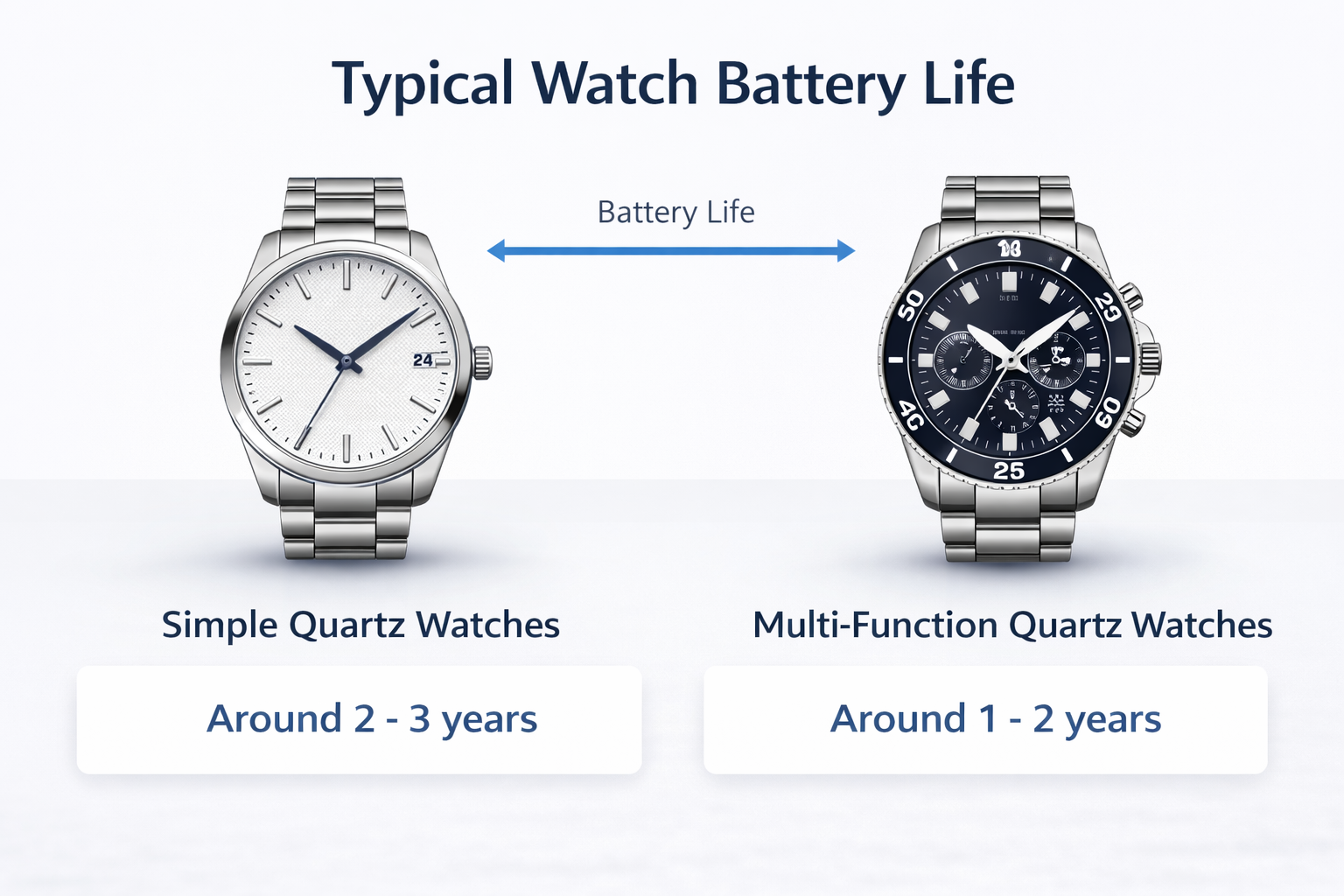
For most quartz watches, a battery usually lasts between 1 and 3 years.
That is the general real-world range most people experience. However, not every watch will behave the same way. Battery life depends on several factors, including:
-
the movement quality
-
how often the watch is used
-
whether the watch has extra functions
-
whether the battery was fresh when installed
-
the overall condition of the watch
A simple three-hand quartz watch may stay within the longer end of that range. A more feature-heavy watch may not.
What Affects Watch Battery Life?
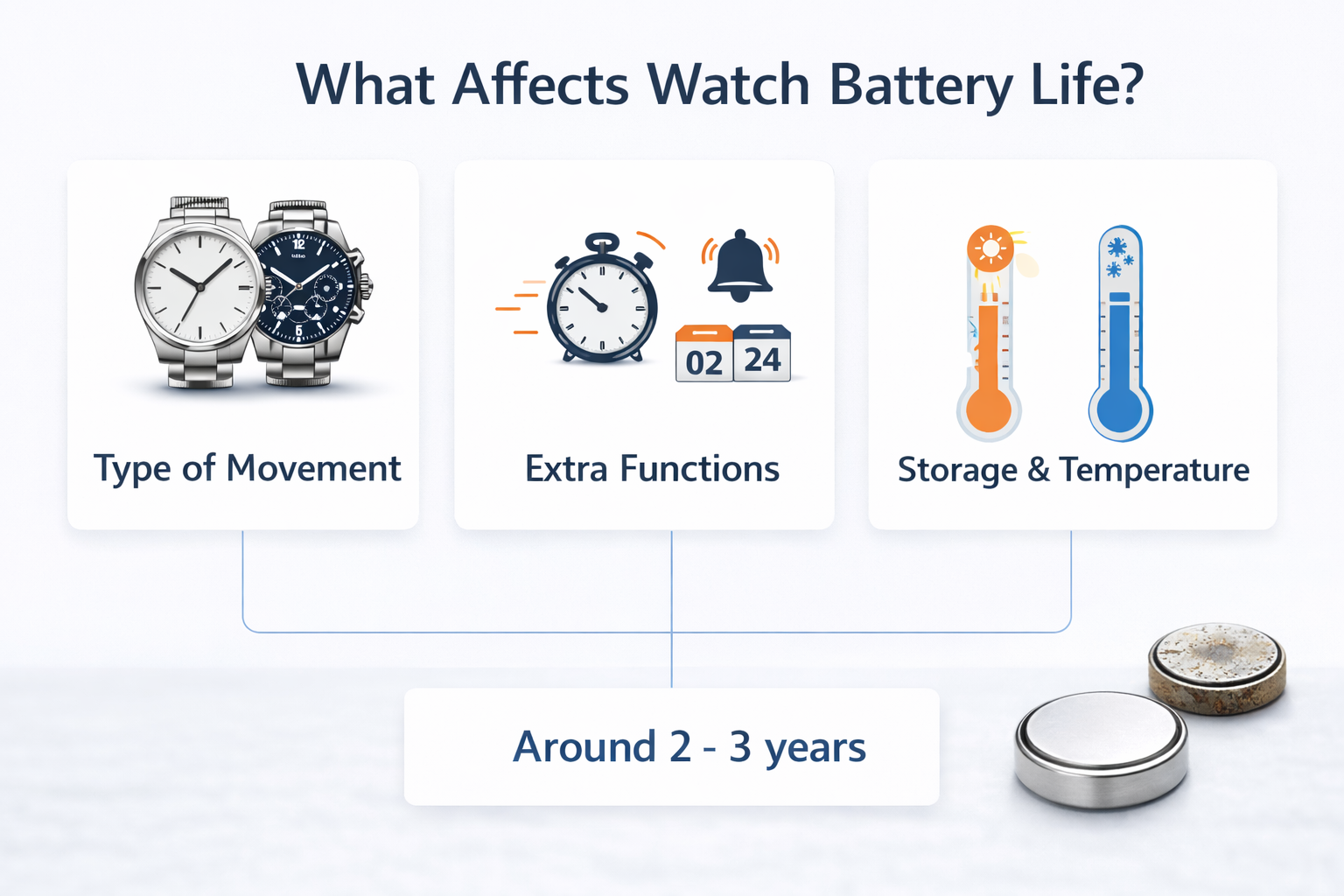
1. Type of Quartz Movement
Not all quartz movements use power in the same way. A basic time-only movement usually uses less energy than a more complex movement with additional complications.
For example, a watch with only:
-
hour hand
-
minute hand
-
seconds hand
-
date window
will usually consume less power than a quartz chronograph or alarm watch.
2. Extra Functions
Battery life often becomes shorter when a watch includes extra features such as:
-
chronograph timing
-
alarm functions
-
digital displays
-
illumination
-
multiple motors or hands
-
perpetual calendars
In general, the more the watch does, the more power it may use.
If you are comparing feature-heavy designs, it also helps to understand watch bezel types explained, because many sportier quartz watches combine added functions with more tool-oriented designs.
3. Battery Quality and Freshness
A battery that has been sitting for a long time before installation may not last as long as a freshly installed one. This is one reason two similar watches can show different battery life even if they use the same movement.
Battery replacement quality also matters. A good battery installed properly will usually give a more predictable ownership experience.
4. Temperature and Storage Conditions
Extreme heat, strong cold, and poor storage conditions can affect battery performance. While most people do not need to worry about this in normal daily use, it can matter if a watch is stored improperly for long periods.
If you often rotate through several watches, our guide on how to store your watch properly is worth reading.
5. Overall Condition of the Watch
Older seals, internal wear, or issues with the movement may affect how efficiently the watch uses battery power. If a battery seems to die unusually fast, the battery itself may not be the only reason.
In some cases, the watch may need servicing or inspection rather than another quick battery swap.
How Long Do Different Quartz Watches Last on One Battery?
Here is a simple practical guide.
Simple Quartz Watches
A basic three-hand quartz watch often lasts around 2 to 3 years, and sometimes more depending on the movement.
Quartz Watches with Date Functions
These are still usually efficient and often fall within the 1.5 to 3 year range.
Quartz Chronographs
Battery life is often shorter, especially if the chronograph is used regularly. These may last around 1 to 2 years in many cases.
Digital or Multi-Function Watches
Battery life can vary a lot. Some are very efficient, while others use more power because of lights, alarms, sensors, or extra displays.
The key idea is simple:
the more complex the watch, the more likely battery life becomes shorter.
How Do You Know a Watch Battery Is Dying?
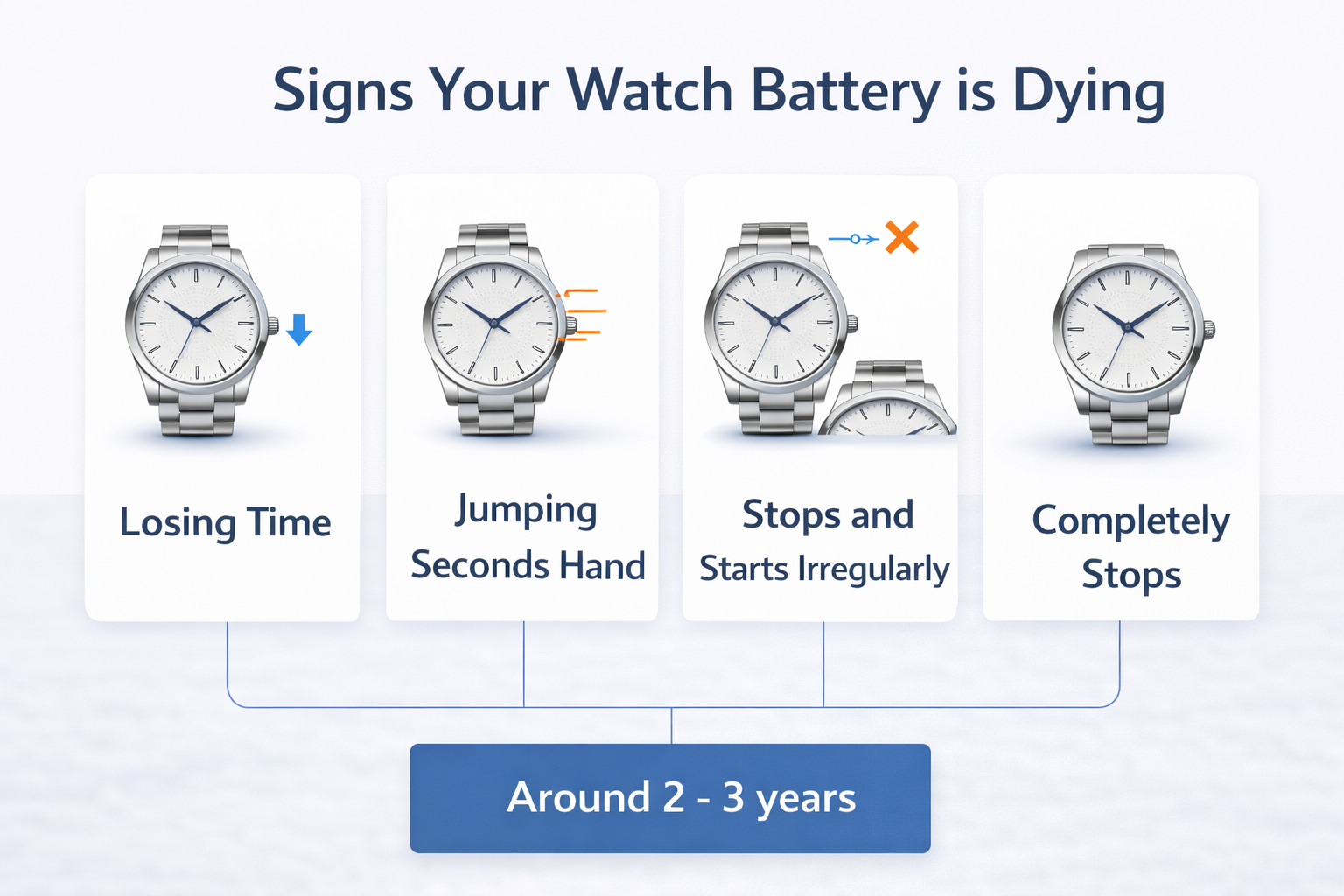
A dying watch battery does not always mean the watch stops instantly. Sometimes it gives warning signs first.
Common signs include:
-
the watch starts losing time
-
the seconds hand begins jumping in larger steps
-
the watch stops and starts irregularly
-
chronograph or extra functions become unreliable
-
the watch stops completely
Some quartz watches use an end-of-life indicator, often seen when the seconds hand jumps every few seconds instead of every second. That is a sign the battery may need replacing soon.
Is It Bad to Leave a Dead Battery in a Watch?
Yes, it is generally better not to leave a dead battery inside a watch for too long.
An old or fully depleted battery can increase the risk of leakage over time, and that can damage the movement. If a quartz watch has stopped and you know you are not going to use it for a while, it is usually smarter to deal with the battery rather than ignore it.
If long-term care matters to you, our guide on how to protect your watch from daily wear and damage may also help.
How Much Does Watch Battery Life Differ from Automatic Watches?
This is one of the biggest practical differences between quartz and automatic watches.
A quartz watch depends on a battery, so eventually that battery will need replacing. An automatic watch does not use a battery, but it depends on mechanical movement and regular wear or winding to keep running.
If you are comparing the two, our article on mechanical vs quartz watches gives a broader overview of how they differ in real ownership.
Can a Watch Battery Last Longer Than 3 Years?
Yes, it can.
Some efficient quartz watches may go beyond 3 years, especially if they are simple, well-made, and do not use extra functions heavily. But it is safer to think in practical terms rather than expecting the maximum possible battery life every time.
For most buyers, expecting around 1 to 3 years is the most realistic answer.
Does Battery Life Affect Which Watch You Should Buy?
It can, especially if you prefer low-maintenance ownership.
A simple quartz watch can be one of the easiest watches to own because it is accurate, practical, and does not need daily winding. For many people, replacing a battery every few years is a small tradeoff.
Battery life becomes a bigger consideration if you are choosing between:
-
a simple quartz watch
-
a feature-heavy quartz watch
-
an automatic watch
If your priority is low-maintenance daily wear, quartz is still one of the easiest choices. If you are still deciding what style fits your routine, our guide on how to choose the right watch for everyday wear may help.
Common Mistakes Buyers Make
One common mistake is assuming every quartz watch battery lasts the same amount of time. That is not true. A simple quartz dress watch and a quartz chronograph can behave very differently.
Another mistake is replacing the battery repeatedly without considering whether the watch itself has another issue. If battery life seems unusually short, the movement or seals may need attention.
Some buyers also leave a dead battery inside a watch for too long, which is a risk worth avoiding.
How to Make a Watch Battery Last Longer
You cannot completely control battery life, but a few habits can help:
-
avoid leaving the watch in extreme heat
-
replace the battery promptly when it dies
-
store the watch properly
-
avoid unnecessary use of power-hungry functions
-
have the watch checked if battery life seems unusually short
These are small habits, but they can improve long-term ownership.
Should You Worry About Quartz Watch Battery Life?
For most people, not really.
Battery replacement every few years is normal quartz watch ownership. It is not usually a major downside unless you strongly prefer mechanical watches or want to avoid any periodic battery maintenance.
For many buyers, the benefits of quartz accuracy and convenience easily outweigh the need for occasional battery replacement.
Final Verdict
If you want the simplest answer, most watch batteries last about 1 to 3 years, with simple quartz watches often lasting longer than more complicated ones.
Battery life depends on the movement, the watch’s features, battery quality, and how the watch is used. A basic quartz watch is usually a very easy low-maintenance choice, while feature-heavy quartz watches may need battery changes more often.
The most important thing is not chasing the longest possible number. It is understanding what is normal for the kind of watch you own.
Key Takeaways
-
most watch batteries last around 1 to 3 years
-
simple quartz watches often last longer than chronographs or multi-function watches
-
extra features usually reduce battery life
-
a jumping seconds hand can be a sign of low battery
-
dead batteries should not be left in a watch for too long
-
unusually short battery life can point to a watch issue, not just a weak battery
-
quartz watches are still one of the easiest low-maintenance watch options
FAQ
How long does a battery last in a quartz watch?
Most quartz watch batteries last around 1 to 3 years, depending on the movement and how many extra features the watch uses.
Why did my watch battery die so fast?
A battery may die faster because of a more complex movement, frequent use of extra functions, an older battery, or a possible issue with the watch itself.
Do chronograph watches use batteries faster?
Yes, many quartz chronographs use batteries faster than simple three-hand quartz watches because they have more functions and consume more power.
Can a watch battery last 5 years?
Some watches can last that long, but it is not the safest general expectation. For most buyers, 1 to 3 years is the more realistic range.
Should I remove a dead battery from a watch?
Yes, it is usually best not to leave a dead battery inside a watch for too long because leakage can damage the movement.
