
What Is Lug to Lug on a Watch? Why It Matters More Than Case Size
What Is Lug to Lug on a Watch? Why It Matters More Than Case Size

When most people shop for a watch, they look at the case diameter first.
You will often hear someone say a watch is 36mm, 40mm, or 42mm, and many buyers assume that number tells them everything they need to know about how the watch will fit.
But in reality, case size is only part of the story.
A watch can have a moderate case diameter and still wear very large on the wrist. On the other hand, a bigger watch can sometimes wear smaller than expected. One of the biggest reasons for this is a measurement called lug to lug.
If you have ever tried on a watch that looked perfect online but felt awkward once it was on your wrist, lug to lug may have been the reason.
In this guide, we will explain what lug to lug means, why it matters, how to measure it, and how to use it to choose a watch that actually fits comfortably.
What Does Lug to Lug Mean on a Watch?

Lug to lug refers to the total length of a watch case from the tip of the top lug to the tip of the bottom lug.
The lugs are the parts of the watch case where the strap or bracelet attaches. When you measure from one end of the lugs to the other, you get the full vertical length of the watch as it sits on the wrist.
This is important because the lugs are often the parts that extend furthest across your wrist. Even if the case diameter seems reasonable, long lugs can make the watch feel oversized.
In simple terms:
-
Case diameter tells you how wide the watch is
-
Lug to lug tells you how long the watch is from top to bottom
For actual wrist comfort, lug to lug often matters more.
Why Lug to Lug Matters More Than You Think
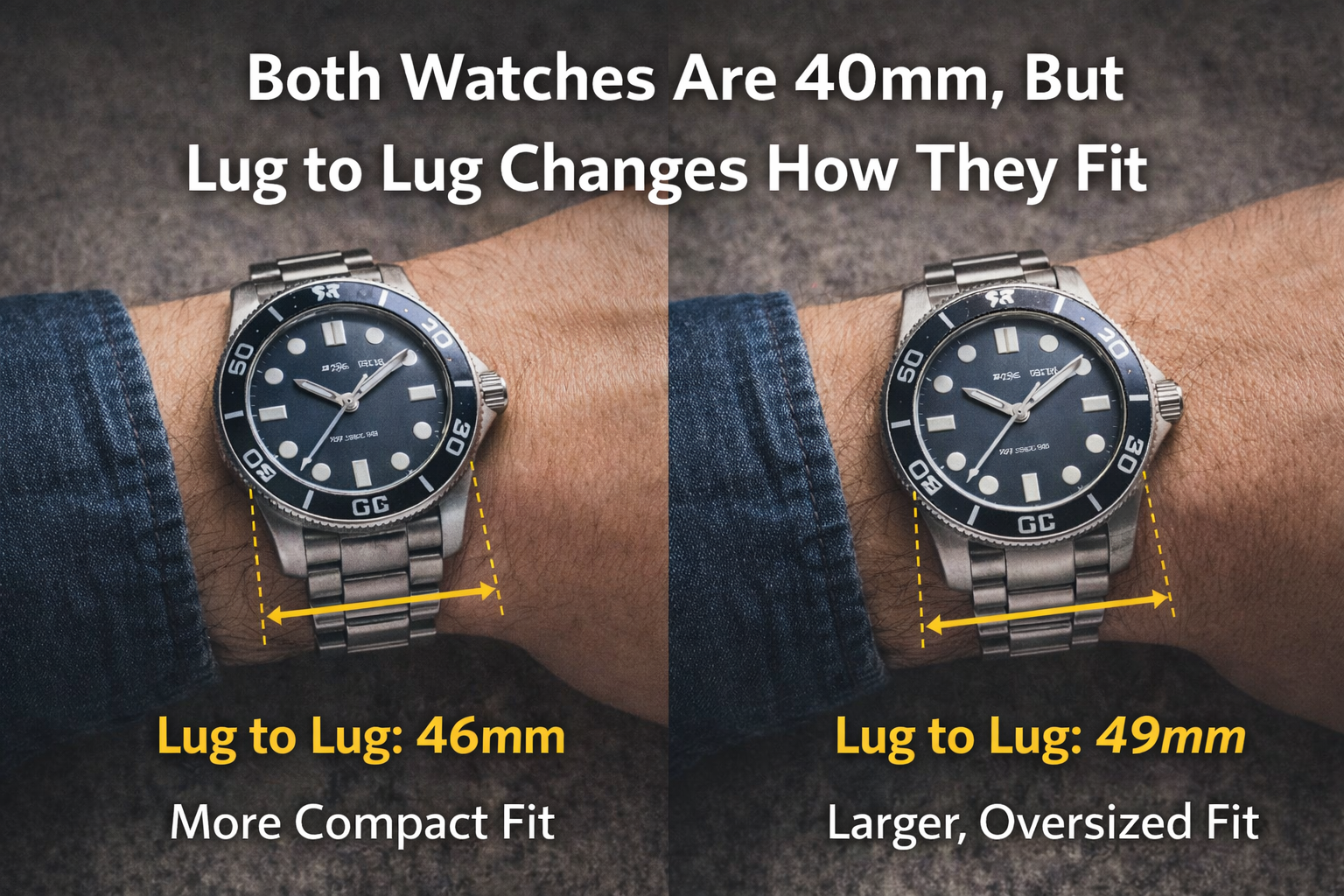
A lot of people buy watches based only on the diameter, but this can be misleading.
For example, two different watches may both be 40mm in diameter, yet one may wear much larger than the other. That usually happens because one has a longer lug to lug measurement.
When the lug to lug distance is too long for your wrist, several things can happen:
-
The lugs may overhang the edges of your wrist
-
The watch may feel less balanced
-
The strap may angle downward awkwardly
-
The watch may look larger than intended
-
Long-term comfort may decrease
This is why someone with a smaller wrist can sometimes wear a 40mm watch comfortably, while another 40mm watch looks and feels too big.
If you are still learning how to choose the right watch size, understanding lug to lug will help you make much better decisions before buying.
Lug to Lug vs Case Diameter: What’s the Difference?

These two measurements work together, but they do not mean the same thing.
Case Diameter
Case diameter measures the width of the watch case, usually excluding the crown.
This is the number most brands advertise first.
Lug to Lug
Lug to lug measures the overall length from the top lug to the bottom lug.
This affects how much space the watch takes up across your wrist.
Why the Difference Matters
A watch with a short lug to lug length can feel compact and comfortable, even if the case diameter is relatively large.
A watch with a long lug to lug length may feel too big, even when the case diameter sounds modest.
That is why many experienced collectors look at both numbers before buying a watch.
If you have ever wondered what watch size should you wear, the answer is not just about diameter. The shape of the case, the length of the lugs, and the way the watch sits on your wrist all matter.
How to Measure Lug to Lug Correctly
Measuring lug to lug is simple once you know what to look for.
Method 1: Check the Brand Specifications
Some watch brands list lug to lug measurements in the product description.
This is the easiest method, but not all brands include it.
Method 2: Use a Ruler or Caliper
If you already have the watch in hand, place it flat on a table and measure from the outermost tip of the top lug to the outermost tip of the bottom lug.
For the most accurate result:
-
Lay the watch flat
-
Measure in a straight vertical line
-
Ignore the strap
-
Focus only on the case and lugs
Method 3: Compare with a Watch You Already Own
If you already wear a watch that fits well, compare its lug to lug measurement with the one you are considering.
This is one of the most practical ways to predict comfort.
What Lug to Lug Length Fits Your Wrist Best?
There is no perfect number for everyone, but there are some helpful general guidelines.
A good rule is that the lug to lug length should not exceed the flat width of your wrist too much.
If the lugs extend beyond your wrist, the watch will usually look and feel too large.
Here are some rough guidelines:
-
Small wrists often wear best with shorter lug to lug measurements
-
Medium wrists can usually handle moderate lengths comfortably
-
Larger wrists often have more flexibility with longer cases
However, wrist shape matters too. A flatter wrist may wear longer watches better than a very round wrist of the same circumference.
This is also why two people can have the same wrist size but very different results with the same watch.
When choosing the right watch for everyday wear, comfort matters just as much as style. A well-proportioned watch will usually feel better throughout the day and look more balanced in everyday situations.
Why Some Watches Wear Smaller or Larger Than Expected
Lug to lug is one of the biggest reasons, but it is not the only one.
A watch may wear differently depending on:
-
Case shape
-
Bezel width
-
Dial opening
-
Lug design
-
Strap integration
-
Case thickness
-
Curved or straight lugs
For example, a watch with sharply extended straight lugs may wear much longer than one with short curved lugs, even if both have the same diameter.
Integrated bracelet designs can also change the way a watch sits on the wrist, sometimes making it feel larger.
This is why dimensions on paper are helpful, but proportions matter just as much.
Common Mistakes People Make When Choosing Watch Size
Many buyers make the same sizing mistakes, especially when shopping online.
1. Looking Only at Case Diameter
This is the most common mistake. Diameter alone does not tell the full story.
2. Ignoring Lug Shape
Long straight lugs tend to wear larger than compact curved lugs.
3. Not Comparing with Wrist Shape
Wrist circumference is useful, but wrist shape is equally important.
4. Assuming Bigger Always Looks Better
A larger watch is not always more stylish. Proportion usually looks better than sheer size.
5. Forgetting Daily Comfort
A watch that looks good in photos may not feel right after wearing it for hours.
A Simple Way to Judge Fit Before Buying
If you are shopping online and cannot try the watch in person, use this quick checklist:
-
Check the case diameter
-
Check the lug to lug measurement
-
Compare both with a watch you already wear comfortably
-
Look at side-profile photos if available
-
Notice whether the lugs are long, straight, or curved
-
Read reviews that mention wrist size and fit
This takes a little more time, but it can save you from buying a watch that looks wrong or feels uncomfortable.
Does Lug to Lug Matter for Every Type of Watch?
Yes, but it may matter more for some categories than others.
For example:
-
Dress watches often look better with more compact proportions
-
Dive watches can sometimes wear larger, but lug length still matters
-
Field watches usually benefit from balanced, practical dimensions
-
Sports watches may feel bulky if the lugs are too long
No matter the style, the goal is the same: the watch should sit naturally on the wrist without looking awkward or feeling unstable.
Final Thoughts
So, what is lug to lug on a watch?
It is the measurement from the tip of the top lug to the tip of the bottom lug, and it plays a major role in how a watch actually fits on your wrist.
While case diameter gets most of the attention, lug to lug often tells you more about whether a watch will feel balanced, comfortable, and proportional.
If you want a watch that truly fits well, do not rely on diameter alone.
Look at the full shape of the watch, including the lugs, and compare those measurements with your own wrist and with watches you already enjoy wearing.
In the end, the best watch size is not just the one that sounds good on paper.
It is the one that feels right when you wear it.
FAQ
What does lug to lug mean on a watch?
Lug to lug refers to the total length of a watch case from the tip of the top lug to the tip of the bottom lug. It helps show how long the watch will sit across your wrist.
Is lug to lug more important than case size?
In many cases, yes. Case size tells you the width of the watch, but lug to lug often has a bigger effect on how the watch actually wears and whether it overhangs your wrist.
What is a good lug to lug size for a watch?
A good lug to lug size depends on your wrist size and shape. In general, the watch looks best when the lugs do not extend too far beyond the edges of your wrist.
How do I measure lug to lug on a watch?
You can measure it from the outer tip of the top lug to the outer tip of the bottom lug using a ruler or caliper, with the watch laid flat.
Can two watches with the same case size wear differently?
Yes. Two watches with the same case diameter can wear very differently if their lug to lug measurements, case shapes, or lug designs are different.
Why does my watch feel bigger than its listed size?
It may have a long lug to lug measurement, thick case sides, wide dial opening, or straight lugs that make it wear larger on the wrist.
