
Best Watch Size for Small Wrists: Practical Sizing Tips That Actually Work
Best Watch Size for Small Wrists: Practical Sizing Tips That Actually Work
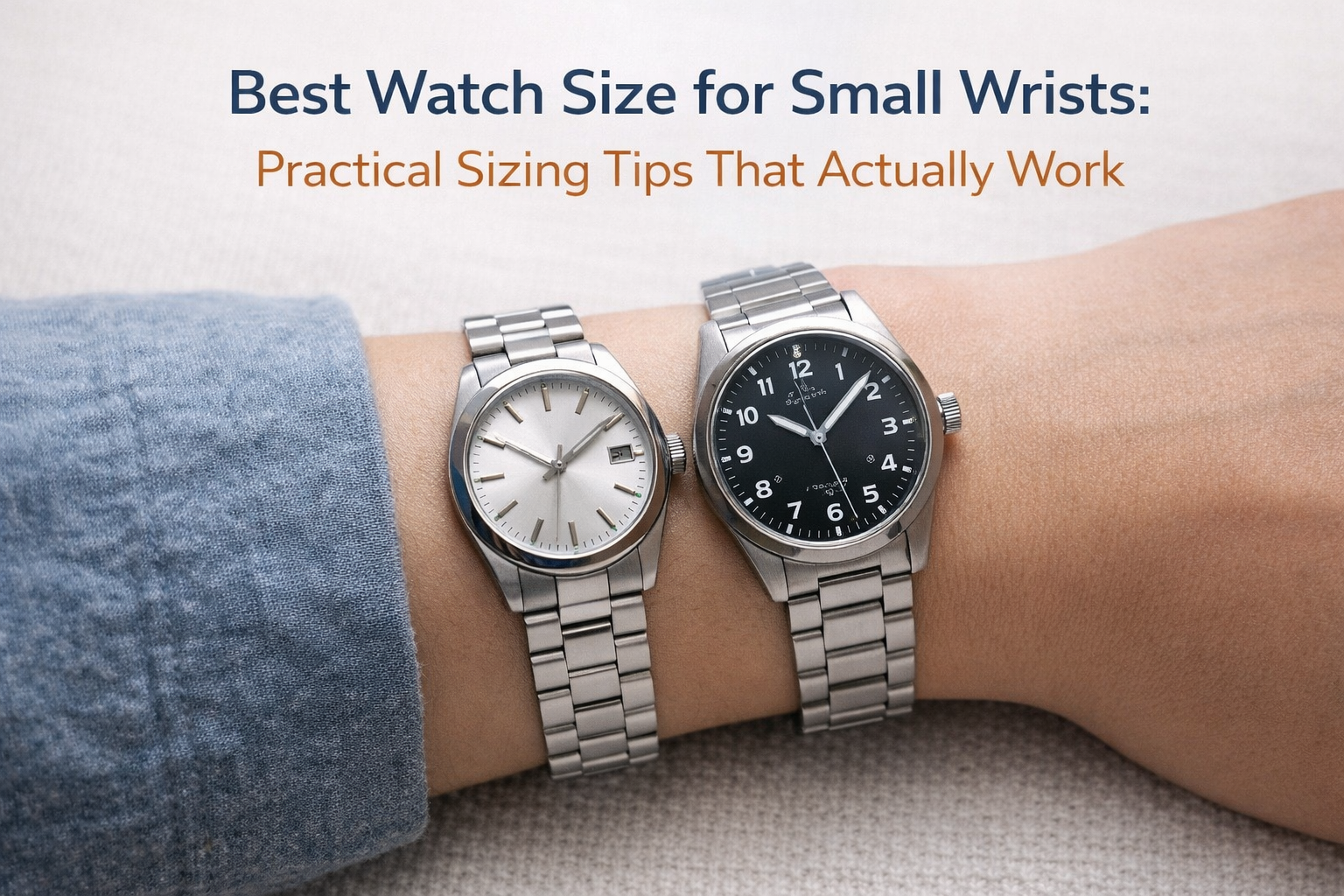
Quick Answer
For most people with small wrists, the best watch size is usually 34mm to 38mm, though some 39mm to 40mm watches can still work well if the lug-to-lug length is compact and the case is not too thick.
The biggest mistake small-wrist buyers make is focusing only on case diameter. In real life, lug-to-lug length, case thickness, dial opening, and strap style often matter just as much as the millimeter number on the spec sheet.
Why Small-Wrist Buyers Often Struggle More Than Other Watch Buyers
If you have a small wrist, you have probably already noticed something frustrating: a watch that looks perfectly normal in product photos can suddenly look oversized once it is on your arm.
This happens all the time. Many watch listings highlight only the case diameter, but that number alone does not tell you how a watch will actually wear. A 40mm watch can look balanced on one wrist and oversized on another. A 38mm watch can feel elegant in one design and still wear large in another.
That is why small-wrist buyers usually need to shop more carefully than average. The good news is that once you understand what to check, choosing the right watch becomes much easier.
If you have not already measured your wrist, start with our guide on how to measure your wrist for the right watch size before comparing specific case sizes.
What Counts as a Small Wrist?
There is no perfect universal rule, but in practical watch buying, a small wrist is often around:
-
5.5 to 6.5 inches
-
roughly 14 to 16.5 cm
That does not mean every person in that range should wear the exact same size watch. It simply means you will usually benefit from more compact proportions and more careful sizing choices.
The Best Watch Size Range for Small Wrists
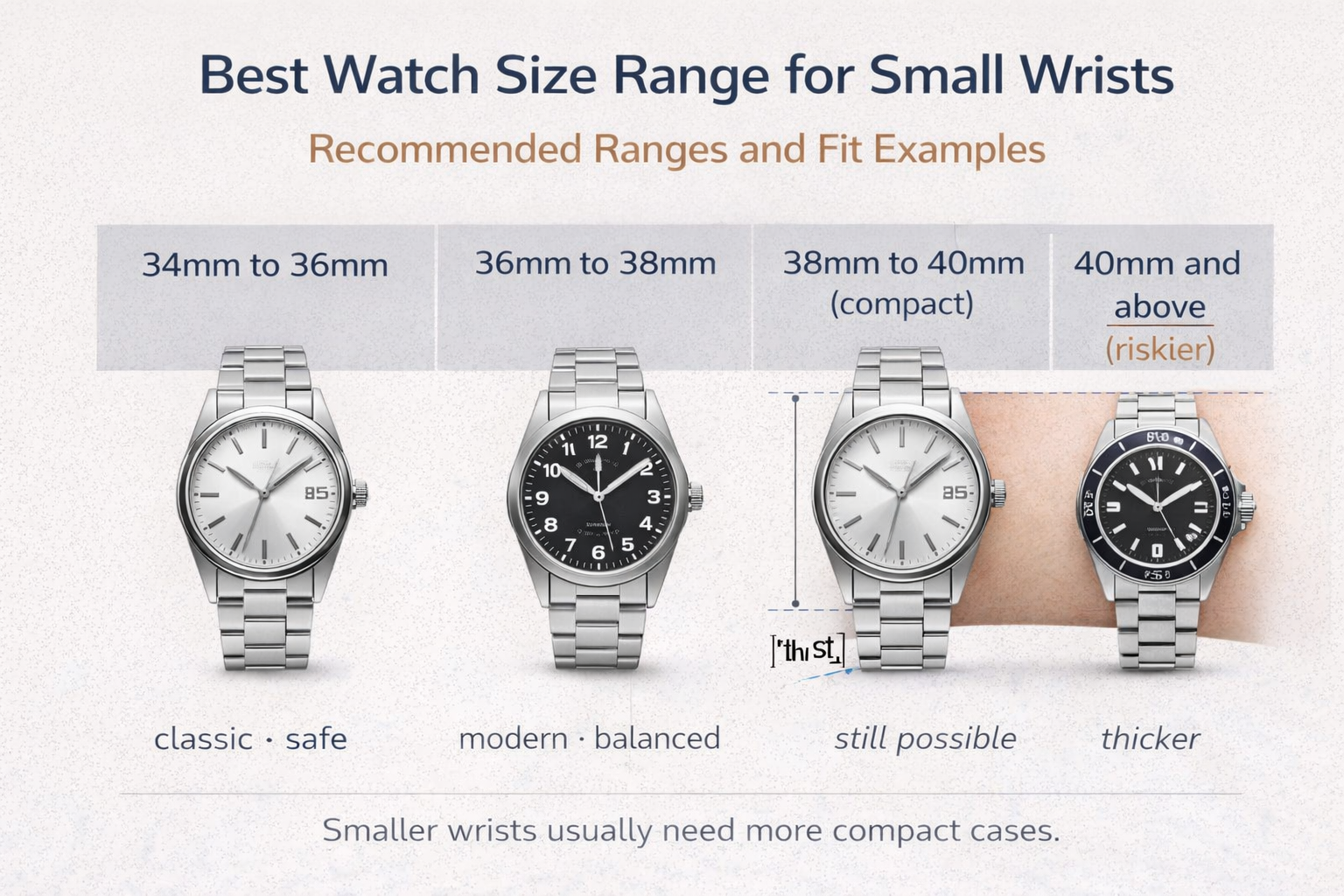
For most small wrists, these ranges work best:
34mm to 36mm
This is often the safest and most classically balanced range, especially for dress watches, dress-casual watches, and minimalist watches.
36mm to 38mm
For many people with small wrists, this is the best all-around modern range. It usually feels balanced without looking too tiny or too oversized.
38mm to 40mm
This can still work on a small wrist, but only if the watch is designed compactly. A shorter lug-to-lug length and thinner case make a big difference here.
40mm and above
This is where many small-wrist buyers start running into problems, especially if the watch is thick, luggy, or built like a large dive watch. It can still work in some cases, but it is much riskier.
Why Case Diameter Is Not Enough
A lot of people search for “best watch size for small wrists” expecting one simple number. In reality, that number is only the beginning.
If you only check case diameter, you can still end up with a watch that feels too big because of:
-
long lugs
-
thick case walls
-
a very open dial
-
a wide bracelet
-
a heavy overall build
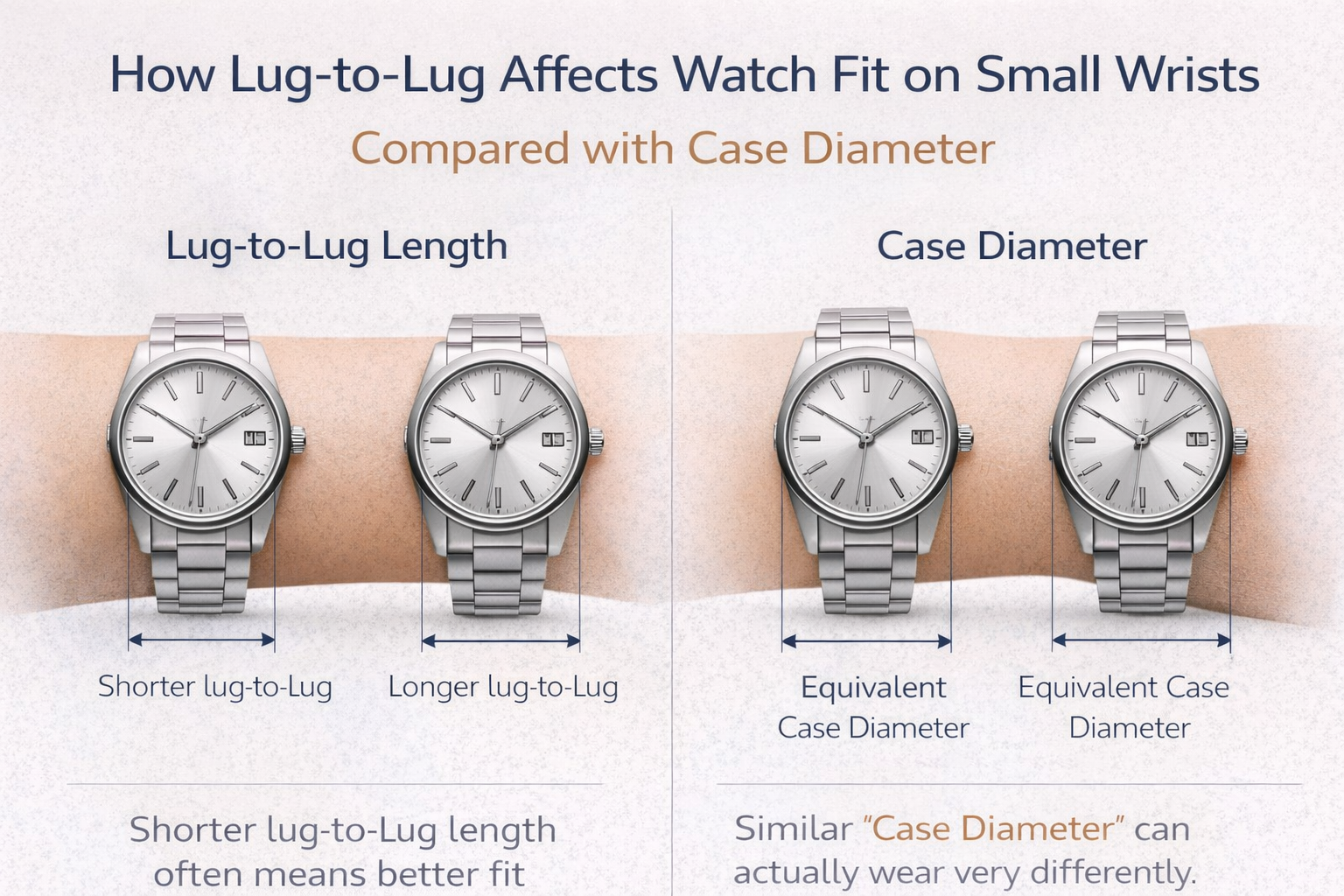
That is why two 38mm watches can wear completely differently.
If you want a fuller explanation of how size numbers work together, our article on what size watch should you wear is worth reading alongside this one.
The 4 Measurements Small-Wrist Buyers Should Always Check
1. Case Diameter
This is the easiest number to find, and it is still useful. For small wrists, starting in the 34mm to 38mm zone is usually safest.
Real-World Example
A buyer with a 6.0-inch wrist may find:
-
a 36mm field watch feels balanced and easy
-
a 38mm everyday watch feels slightly more modern but still safe
-
a 42mm dive watch feels too dominant, even if the buyer likes the style
This is why diameter matters, but only as a starting point.
2. Lug-to-Lug Length
This is often the most important number for small wrists.
Lug-to-lug is the total length from the top lug to the bottom lug. If it is too long, the watch can visually overhang your wrist and instantly look too large.
Practical Rule
For small wrists, a shorter lug-to-lug usually matters more than chasing the smallest case diameter.
Real-World Example
Imagine two 38mm watches:
-
Watch A has a 44mm lug-to-lug
-
Watch B has a 48mm lug-to-lug
Even though both are 38mm, Watch A will often wear much better on a small wrist.
This is one of the biggest reasons people buy the “right diameter” and still end up unhappy.
3. Case Thickness
Thick watches tend to look larger, feel heavier, and stand higher on the wrist. On a small wrist, that can make a watch feel more awkward even if the diameter looks acceptable.
This matters especially with:
-
dive watches
-
chronographs
-
tool watches
-
chunky sports watches
Practical Tip
If you have a small wrist and want an easy everyday fit, lean toward a watch that is not excessively thick.
If comfort matters just as much as appearance, our guide on how tight a watch should be can help you avoid a watch that feels bulky even when the size looks correct on paper.
4. Strap or Bracelet Style
Strap style can completely change how a watch wears.
For example:
-
a soft leather strap can make a watch feel slimmer and more compact
-
a rubber strap can feel lighter and more casual
-
a wide steel bracelet can make the same case feel more substantial
This is why the same watch head can wear differently depending on what it is attached to.
If you are comparing daily wear options, our article on best watch strap material for everyday wear can help you choose more intelligently.
Best Watch Styles for Small Wrists
Some watch categories are naturally easier for small wrists than others.
Best Easy Choices
These are often the most forgiving:
-
field watches
-
dress watches
-
dress-casual watches
-
minimalist watches
-
vintage-inspired everyday watches
More Difficult Choices
These are more likely to wear large:
-
oversized dive watches
-
thick chronographs
-
large GMT watches
-
bulky sports watches
That does not mean small wrists can never wear these styles. It just means the buyer needs to check dimensions much more carefully.
If you are still deciding what kind of first watch suits you best, our guide on best watch types for beginners is a helpful reference.
What Actually Looks Good on a Small Wrist?
This is the part many people really want to know.
In most cases, a good-looking watch on a small wrist has these qualities:
-
the lugs do not noticeably overhang
-
the watch sits flat
-
the case does not look top-heavy
-
the strap feels proportional
-
the dial is easy to read without dominating the wrist
A balanced look usually beats a larger watch that feels trendy but awkward.
Practical Example
A person with a 5.9-inch wrist choosing between:
-
a 36mm dress-casual watch
-
a 40mm thick dive watch
will often find the 36mm option looks more natural, is easier to wear daily, and actually makes the wrist look cleaner rather than smaller.
How to Tell If a Watch Is Too Big for a Small Wrist
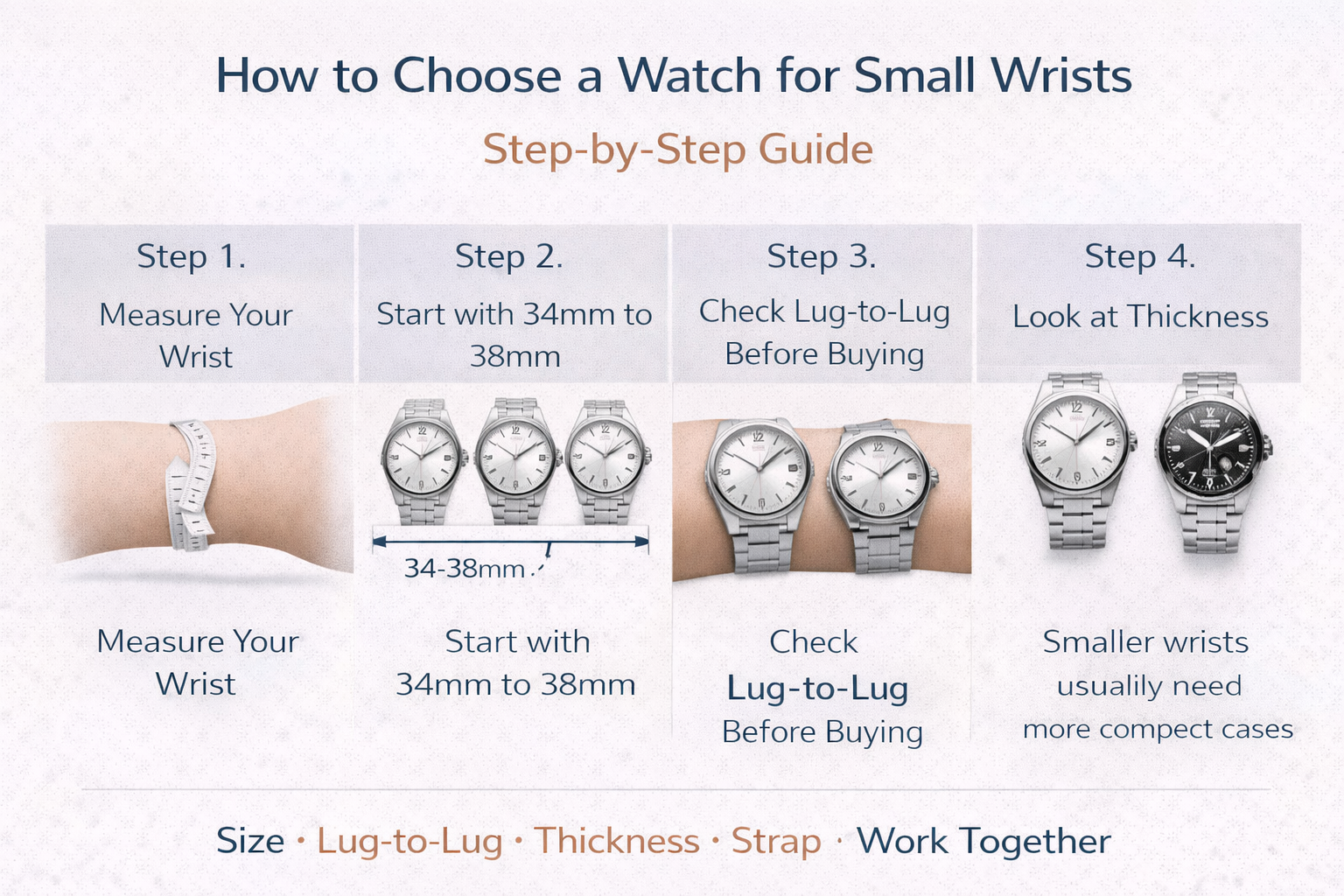
A watch may be too big if:
-
the lugs extend beyond the flat top of your wrist
-
the case looks wider than your wrist can visually support
-
the watch slides around too much
-
it feels top-heavy
-
it draws attention mainly because of size, not balance
Fast Practical Test
If the first thing you notice is “this watch looks huge,” it usually is.
How to Tell If a Watch Is Actually Fine Even If the Number Sounds Big
Sometimes small-wrist buyers reject a watch too quickly because the size number sounds intimidating.
A 39mm or 40mm watch may still work if:
-
it has short lugs
-
the bezel is thick, making the dial look smaller
-
the case is thin
-
the strap helps it sit compactly
-
the watch does not wear flat and long
Real-World Example
A compact 39mm field watch may wear better on a small wrist than a stretched-out 37mm fashion watch with long lugs and a wide dial opening.
So do not judge by case diameter alone.
Step-by-Step: How to Choose a Watch for a Small Wrist
Here is the simplest practical process.
Step 1: Measure Your Wrist
Do not guess. Use a tape measure or string and find your wrist circumference.
Step 2: Start with 34mm to 38mm
This is the safest range for most small wrists.
Step 3: Check Lug-to-Lug Before Buying
If the listing includes this measurement, pay close attention to it.
Step 4: Look at Thickness
If the watch is thick and sporty, treat it as if it may wear larger than the diameter suggests.
Step 5: Consider Strap Type
A leather or slim strap can make the watch feel more compact than a wide steel bracelet.
Step 6: Think About Style
A dress watch and dive watch of the same diameter do not wear the same.
Common Mistakes Small-Wrist Buyers Make
One common mistake is buying a larger watch because they think a smaller watch will make their wrist look smaller. In reality, the opposite often happens. A watch that is too large can make the wrist look even smaller by comparison.
Another mistake is focusing only on trends. Oversized watches may look exciting online, but everyday comfort matters much more.
A third mistake is copying someone else’s preferred size without considering wrist shape, case design, and style category.
If you are also comparing proportions from a quality point of view, our guide on what makes a high-quality watch may help you think beyond size alone.
Should Small-Wrist Buyers Avoid Dive Watches?
Not necessarily, but they should be selective.
A small-wrist buyer can still wear a dive watch if it has:
-
a compact case
-
short lugs
-
reasonable thickness
-
a manageable bracelet or strap
What usually causes problems is not the fact that it is a dive watch. It is when the dive watch is built large in every dimension.
If durability is one of your goals, our article on how to choose a durable watch for long-term use can help you compare practical options that are not automatically oversized.
Final Verdict
If you want the simplest answer, the best watch size for small wrists is usually 34mm to 38mm, with some 39mm to 40mm watches still working well if the overall design is compact.
The smartest way to buy is not to obsess over one number. It is to look at:
-
wrist measurement
-
case diameter
-
lug-to-lug length
-
thickness
-
strap style
For small wrists, balance almost always looks better than size for the sake of size. A well-proportioned watch will feel more comfortable, look more natural, and usually age better with your style over time.
Key Takeaways
-
most small wrists suit watches in the 34mm to 38mm range
-
39mm to 40mm can still work if the lug-to-lug is compact
-
lug-to-lug length often matters more than case diameter
-
thick cases and long lugs usually wear larger
-
field, dress, and everyday watches are often easiest for small wrists
-
strap style can make a big difference in how large a watch feels
-
balanced fit usually looks better than oversized trends on a small wrist
FAQ
What is the best watch size for small wrists?
For most people with small wrists, the best range is usually 34mm to 38mm, depending on the watch’s lug-to-lug length and thickness.
Can someone with a small wrist wear a 40mm watch?
Yes, sometimes. A 40mm watch can work if it has short lugs, a thin case, and a compact overall design.
What matters more for small wrists, case size or lug-to-lug?
Lug-to-lug is often more important because it affects how much wrist space the watch actually takes up.
Are dive watches bad for small wrists?
Not always. Compact dive watches can work well, but oversized and thick models are usually harder to wear on smaller wrists.
Is 36mm too small for a man?
No. For many people, especially those with smaller wrists, 36mm is a classic and very wearable size.
