
How to Measure Your Wrist for the Right Watch Size
How to Measure Your Wrist for the Right Watch Size
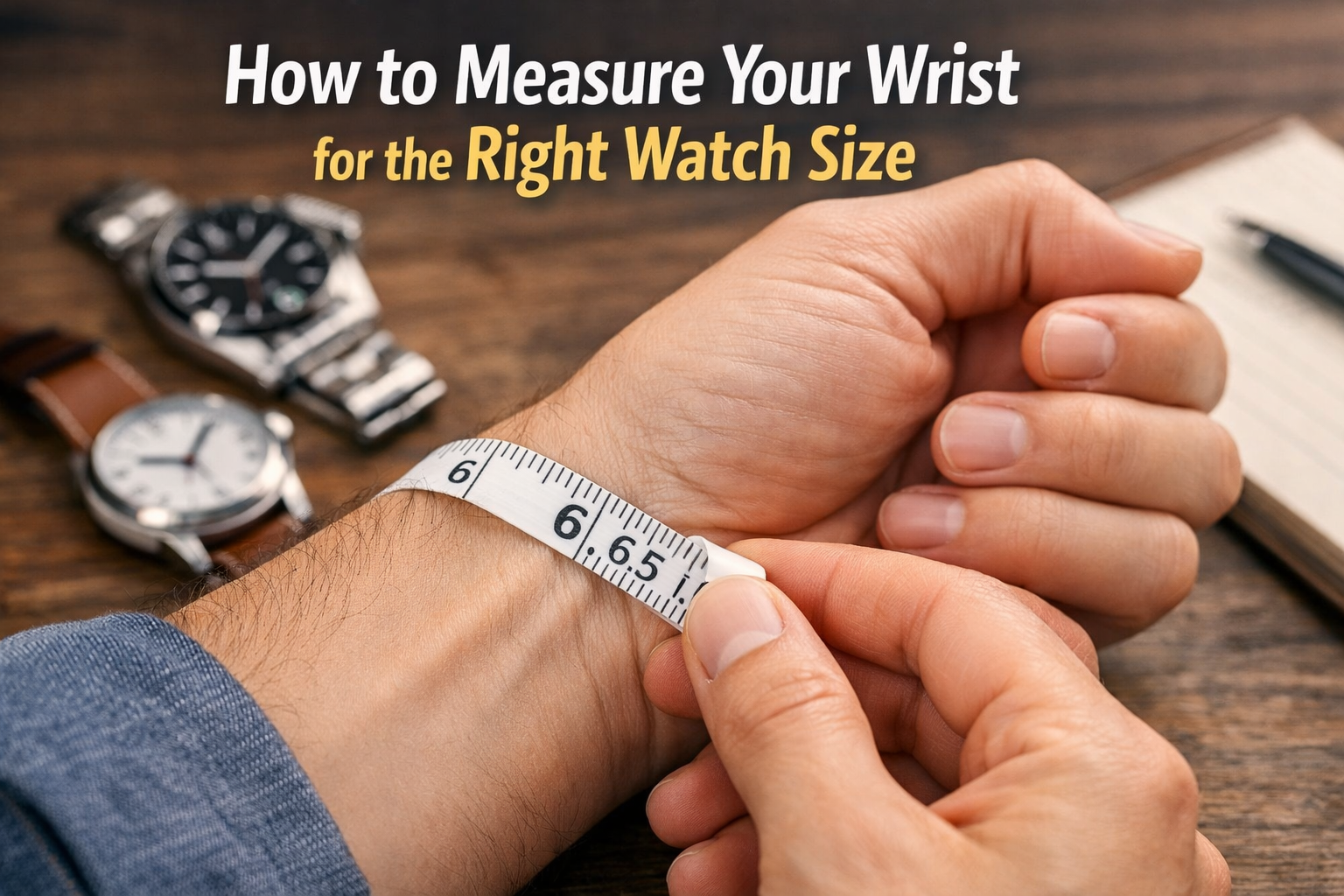
Quick Answer
To measure your wrist for the right watch size, wrap a soft measuring tape around the part of your wrist where you normally wear a watch and note the circumference in inches or centimeters. Once you know your wrist size, you can compare it with a watch’s case diameter, lug-to-lug length, and strap width to find a size that looks balanced and feels comfortable.
For most people, wrist measurement is the best starting point for avoiding a watch that looks too large, too small, or simply feels awkward in daily wear.
Why Wrist Measurement Matters
Many people buy a watch based only on photos, brand, or case diameter. That often leads to disappointment because a watch that looks perfect online may wear very differently on your actual wrist.
The right watch size is not only about the number printed on the spec sheet. It is about proportion, comfort, and how the case sits on your wrist in real life. Measuring your wrist first gives you a much better chance of choosing a watch that looks natural and feels easy to wear.
If you are still comparing general sizing principles, our guide on what size watch should you wear is a useful companion to this article.
What You Need to Measure Your Wrist
The easiest tool is a soft measuring tape, like the kind used for clothing.
If you do not have one, you can also use:
-
a strip of paper
-
a piece of string
-
a ruler
The goal is simple: measure the circumference of your wrist at the point where you would normally wear a watch.
How to Measure Your Wrist Correctly
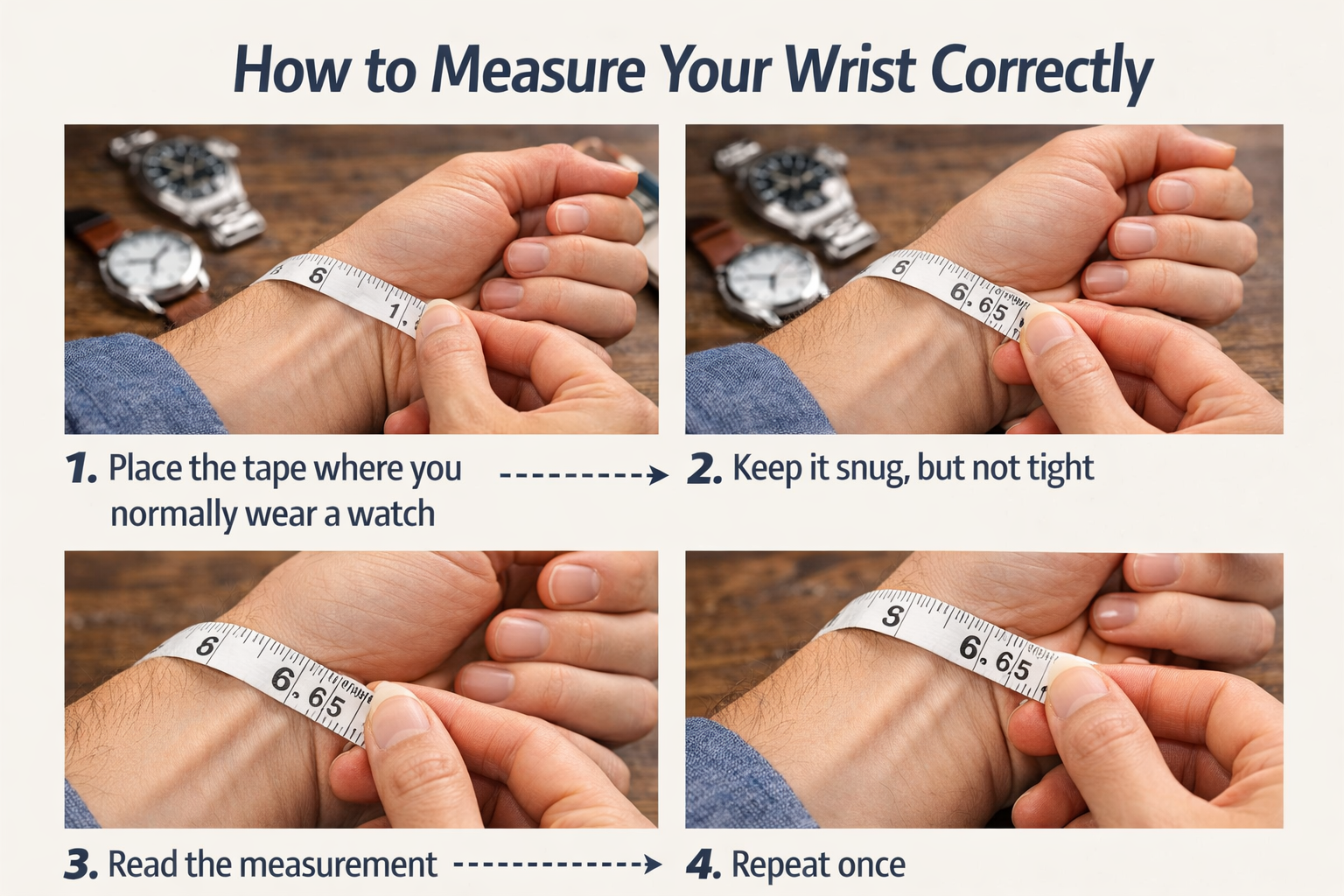
Follow these simple steps:
1. Place the tape where you normally wear a watch
Wrap the tape around your wrist just above the wrist bone or wherever your watch usually sits.
2. Keep it snug, but not tight
Do not pull so tightly that it compresses the skin. You want a realistic everyday measurement, not the smallest number possible.
3. Read the measurement
Record the size in either:
-
centimeters
-
inches
4. Repeat once
Measure again to make sure the number is accurate.
This gives you your wrist circumference, which is the main number you will use when evaluating watch size.
What Is Considered a Small, Medium, or Large Wrist?
There is no universal rule, but a simple practical guide looks like this:
Small wrist
-
around 5.5 to 6.5 inches
-
roughly 14 to 16.5 cm
Medium wrist
-
around 6.5 to 7.5 inches
-
roughly 16.5 to 19 cm
Large wrist
-
around 7.5 inches and above
-
roughly 19 cm and above
These ranges are not strict. They just help you start thinking about what proportions may suit your wrist best.
If you want a broader overview of watch fit, our guide on how to choose the right watch size for your wrist goes further into wrist categories and general balance.
Wrist Size vs Watch Size: What Numbers Matter Most?
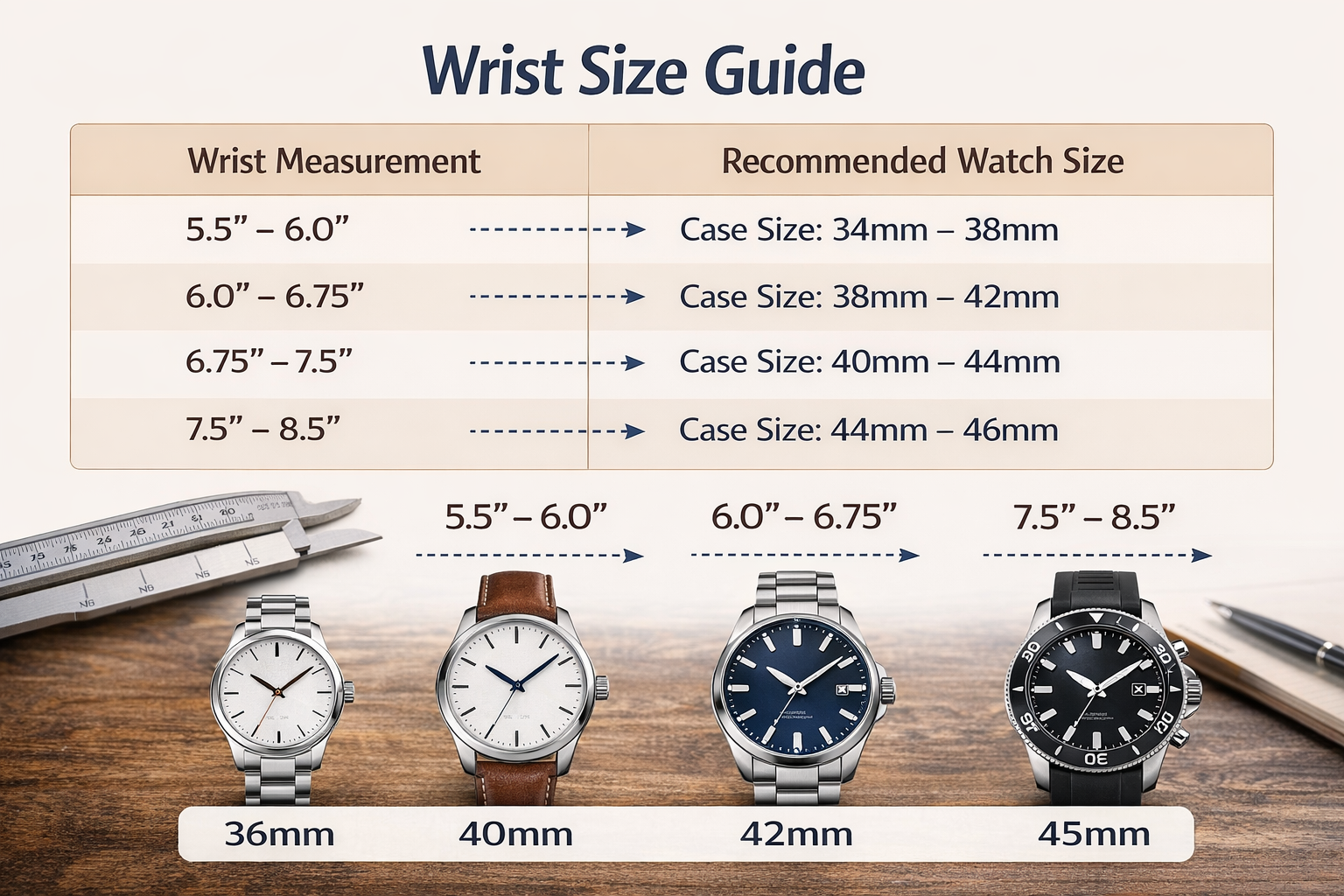
Once you know your wrist measurement, you still need to compare it with the right watch dimensions.
The most important numbers are:
-
case diameter
-
lug-to-lug length
-
case thickness
-
strap or bracelet width
Many beginners focus only on case diameter, but that is not enough on its own.
1. Case Diameter
Case diameter is the width of the watch case, usually measured in millimeters.
This is the number most buyers notice first. Common watch sizes include:
-
36mm
-
38mm
-
40mm
-
42mm
-
44mm
In general:
-
smaller wrists often suit 36mm to 40mm
-
medium wrists often suit 38mm to 42mm
-
larger wrists often suit 40mm and above
But this is only a starting point. A watch with the same diameter can wear very differently depending on the lug-to-lug measurement and case shape.
2. Lug-to-Lug Length
This is one of the most important measurements, and many buyers ignore it.
Lug-to-lug is the distance from the tip of the top lug to the tip of the bottom lug. In real-life wear, this often matters more than case diameter because it determines how much wrist space the watch actually takes up.
As a simple rule:
the lug-to-lug length should usually not exceed the flat width of your wrist too dramatically
If it does, the watch may overhang and look awkward.
This is why two 40mm watches can wear completely differently.
3. Case Thickness
Thickness changes how large or bulky a watch feels.
A thin 40mm dress-casual watch can look refined and compact. A thick 40mm dive watch may feel much larger on the wrist.
Thickness matters especially if you:
-
want the watch to fit under a sleeve
-
prefer a cleaner profile
-
dislike heavy or bulky watches
If daily comfort matters a lot to you, it is also worth reading how tight a watch should be.
4. Strap or Bracelet Width
Strap width affects the visual balance of the watch.
A very narrow strap can make the watch look top-heavy. A wide bracelet can make it feel more substantial and sporty. This is one reason the same case can wear differently on leather, rubber, or metal.
If you are also comparing everyday wear options, our guide on best watch strap material for everyday wear can help.
How to Match Wrist Size with Watch Case Size
Here is a simple everyday guide.
If your wrist is around 5.5 to 6.5 inches
You will often suit:
-
34mm to 38mm comfortably
-
39mm to 40mm if the lug-to-lug is compact
If your wrist is around 6.5 to 7.5 inches
You will often suit:
-
38mm to 42mm very easily
-
some 43mm watches depending on case design
If your wrist is above 7.5 inches
You will often suit:
-
40mm to 44mm comfortably
-
sometimes larger, depending on style
Again, these are starting points, not strict rules.
Why the Same Watch Size Can Wear Differently
This is one of the biggest things buyers miss.
A 40mm minimalist watch may feel smaller than a 40mm dive watch because of:
-
bezel thickness
-
dial opening
-
lug shape
-
case height
-
strap style
-
color contrast
That is why measuring your wrist is step one, but understanding the watch’s overall design matters just as much.
If you are comparing sports watches, our article on watch bezel types explained can also help you understand why some watches wear larger than others.
How to Tell If a Watch Is Too Big
A watch may be too big if:
-
the lugs extend noticeably beyond your wrist
-
the case looks top-heavy
-
it slides around constantly
-
it feels uncomfortable during normal movement
-
it dominates your wrist more than you want
This does not mean oversized watches are always wrong. Some people like a larger look. But for balanced everyday wear, proportion usually matters more than size alone.
How to Tell If a Watch Is Too Small
A watch may feel too small if:
-
it looks visually lost on your wrist
-
the strap appears too wide for the case
-
the dial feels harder to read than expected
-
the overall look feels less balanced than you wanted
Again, this is partly personal preference. Some people prefer a more restrained, classic fit.
Best Way to Measure Without a Tape
If you do not have a soft tape measure, use this method:
-
Wrap a strip of paper or string around your wrist
-
Mark the point where it overlaps
-
Lay it flat against a ruler
-
Record the length
This is usually accurate enough for watch sizing.
Common Mistakes Buyers Make
One common mistake is relying only on case diameter. Another is assuming the same size works for every style. A 40mm field watch, 40mm dress watch, and 40mm dive watch can all wear differently.
Some buyers also forget that fit is not only visual. A watch that technically “fits” can still feel wrong if it is too thick, too heavy, or poorly matched with the strap.
That is why wrist measurement should be the beginning of the process, not the only step.
If you are buying your first serious watch, our guide on best watch types for beginners may also help you narrow down which styles are easiest to size well.
How to Choose the Right Watch After Measuring Your Wrist
Once you know your wrist size, the best approach is this:
Step 1
Choose a rough case size range that fits your wrist.
Step 2
Check the lug-to-lug length.
Step 3
Look at thickness and strap style.
Step 4
Think about how you want the watch to wear:
-
classic and compact
-
balanced everyday fit
-
sporty and slightly larger
The more closely these factors match your wrist and lifestyle, the better the watch will feel over time.
If overall comfort and wearability matter to you, our article on how to choose the right watch for everyday wear is also worth reading.
Final Verdict
If you want the simplest answer, the best way to choose the right watch size is to measure your wrist first, then compare that number with case diameter, lug-to-lug length, and thickness.
For most people, wrist circumference is the easiest and most practical place to start. It helps you avoid watches that look too large, wear awkwardly, or feel uncomfortable after a few hours.
The best watch size is not just the one that is popular online. It is the one that fits your wrist naturally and makes the watch easy to wear every day.
Key Takeaways
-
measure your wrist where you normally wear a watch
-
wrist circumference is the best starting point for choosing size
-
case diameter matters, but lug-to-lug often matters even more
-
thickness and strap width also affect how a watch wears
-
small wrists often suit smaller or more compact designs
-
the same case size can wear differently depending on the watch style
-
a balanced fit usually feels better than simply choosing the biggest size
FAQ
How do I measure my wrist for a watch?
Wrap a soft measuring tape around the part of your wrist where you usually wear a watch, keep it snug but not tight, and record the circumference.
What watch size is best for a 6.5-inch wrist?
Many people with a 6.5-inch wrist find that watches around 36mm to 40mm work well, though lug-to-lug length still matters a lot.
Is case diameter the most important watch measurement?
Not always. Lug-to-lug length is often just as important, and sometimes more important, for how a watch actually fits.
Can I measure my wrist without a tape measure?
Yes. You can use string or paper, mark the overlap point, and then measure it with a ruler.
How do I know if a watch is too big for my wrist?
A watch may be too big if the lugs extend beyond your wrist, the case feels top-heavy, or the watch looks unbalanced in everyday wear.
