
Why Does My Watch Keep Stopping? Common Reasons and What to Do
Why Does My Watch Keep Stopping? Common Reasons and What to Do
Quick Answer
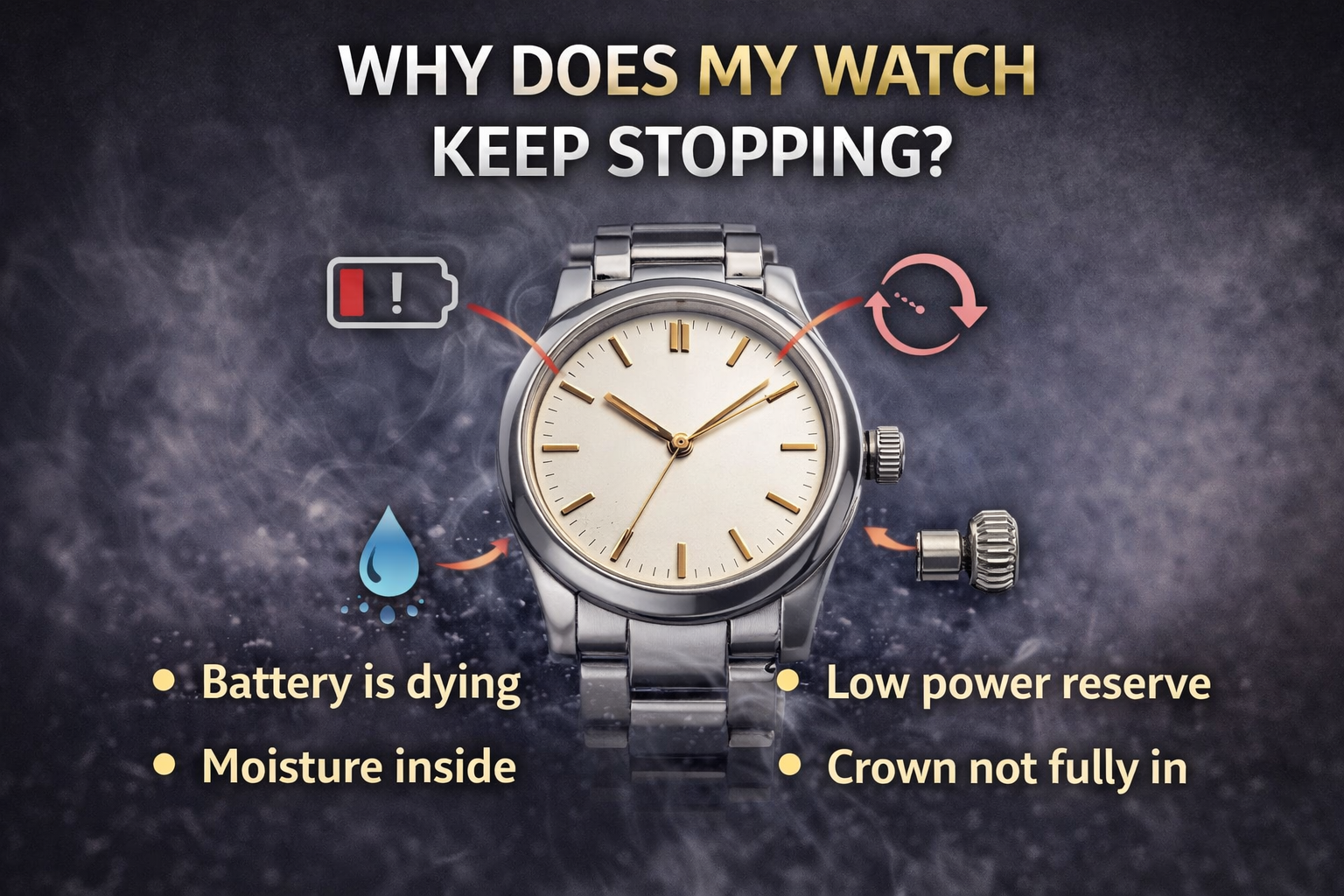
If your watch keeps stopping, the reason usually falls into one of these categories:
- the battery is dying
- the automatic watch is not getting enough movement
- the watch has been left unworn too long
- there is a problem with the crown or setting position
- the movement may need service or repair
For quartz watches, the most common cause is usually a weak battery.
For automatic watches, the most common cause is low power reserve or lack of wrist movement.
If the watch stops repeatedly even after obvious fixes, it may need professional inspection.
Why This Problem Confuses So Many Watch Owners
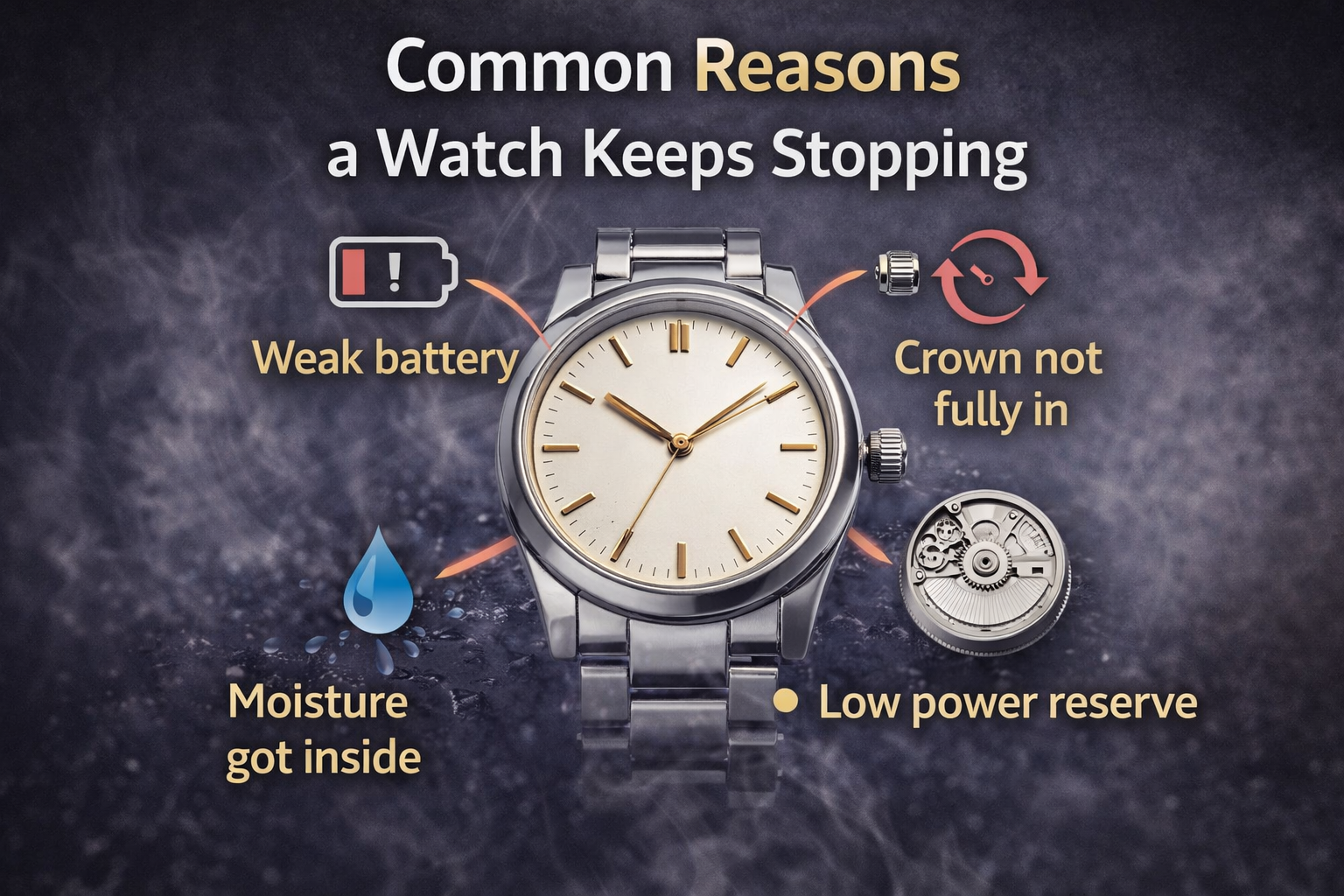
A watch that stops does not always mean it is broken.
That is what makes this issue frustrating.
Sometimes the problem is simple:
- a battery is nearly dead
- the watch has not been worn enough
- the crown is not fully in
- the watch just needs winding
Other times, the stopping is a sign of something more serious:
- worn seals
- movement issues
- old lubrication
- damage from shock or moisture
Real Example
Someone buys an automatic watch, wears it only at a desk for short periods, then notices it stops overnight. They assume it must be defective. In reality, the watch may simply not be getting enough motion to build a proper power reserve.
That is why the smartest first step is not panic. It is identifying what type of watch you have and how it is actually being used.
If you are still comparing basic movement types, mechanical vs quartz watches is a useful starting point because the answer often depends on which one you own.
Step One: Figure Out Whether It Is Quartz or Automatic
Before you try to “fix” anything, identify the watch type.
Quartz Watch
A quartz watch usually:
- runs on a battery
- has a ticking seconds hand
- needs very little day-to-day effort
Automatic Watch
An automatic watch usually:
- runs on a mechanical movement
- depends on wrist motion or winding
- may stop if left unworn too long
This matters because a quartz watch and an automatic watch can stop for completely different reasons.
Why a Quartz Watch Keeps Stopping
If your watch is quartz, the most common reason is still the simplest one:
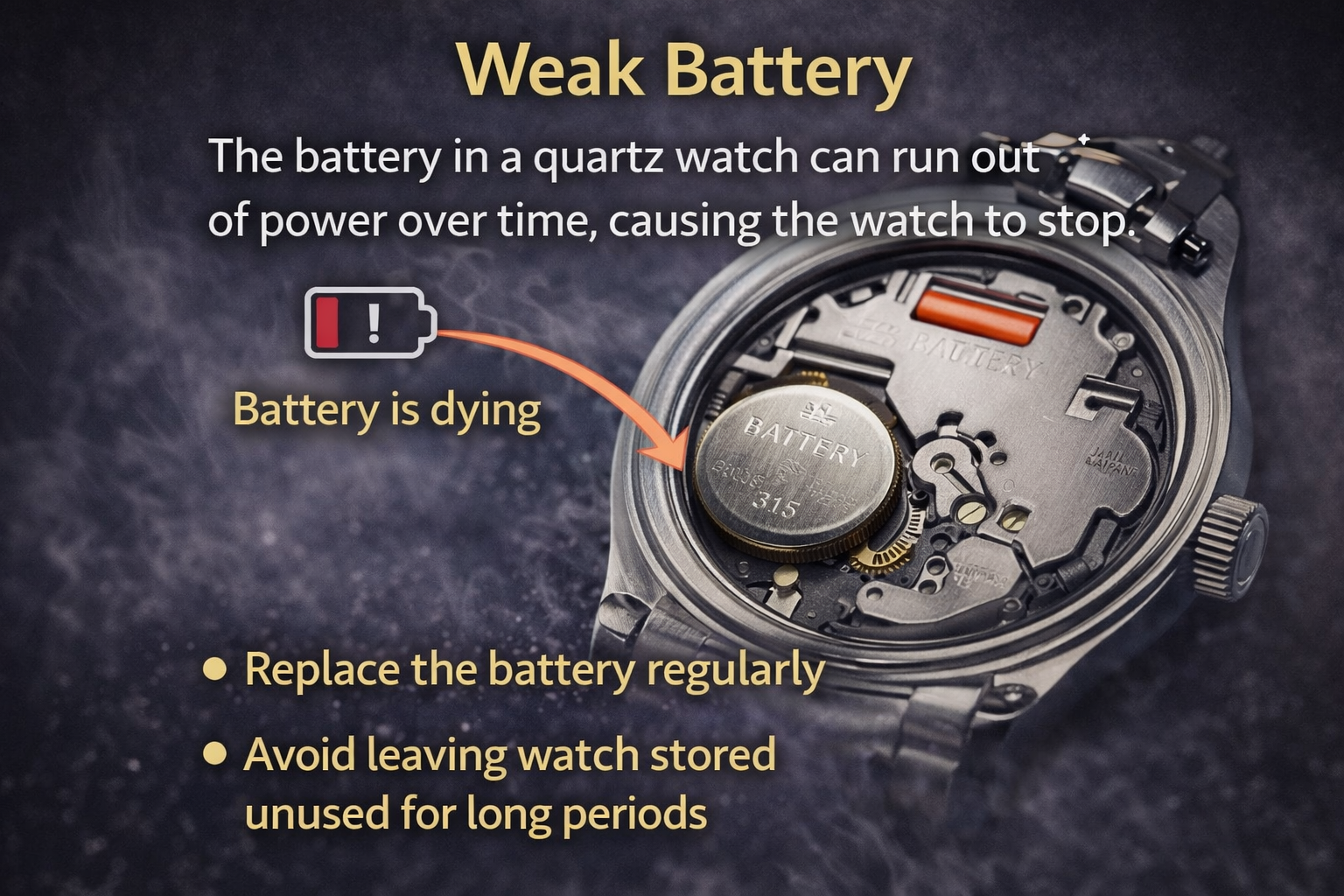
1. The Battery Is Dying
This is the first thing most people should suspect.
A weak battery can cause:
- the watch to stop completely
- the seconds hand to jump strangely
- the watch to stop and restart
- timekeeping to become inconsistent
Real Example
A quartz watch may run normally for most of the day, then stop overnight, then start again when moved. That kind of inconsistent behavior often points to a battery near the end of its life.
If you want the full battery side of this issue, how long does a watch battery last is directly relevant here.
2. The Battery Was Replaced Poorly
Sometimes the battery itself is not the real problem.
A bad battery replacement can create other issues, such as:
- improper sealing
- poor contact
- movement disturbance
- crown or gasket problems
If the watch started acting strangely soon after a battery change, that detail matters.
3. The Quartz Movement Has a Fault
If the battery is fresh and the watch still stops, the movement itself may have an issue.
That becomes more likely when:
- the watch is older
- it has had water exposure
- it has been dropped
- it has been sitting unused for years
Why an Automatic Watch Keeps Stopping
If your watch is automatic, the most common causes are different.
4. It Is Not Getting Enough Wrist Movement
This is probably the most common cause for newer automatic-watch owners.
A lot of people assume “wearing it” automatically means “fully powering it.”
That is not always true.
If your day is mostly:
- typing
- sitting
- driving
- light desk work
your watch may not build enough reserve to keep running long.
Real Example
Someone wears an automatic watch for eight hours but spends most of the day at a computer. The watch stops the next morning. That does not necessarily mean anything is wrong. It may just mean the movement never built enough reserve.
This connects closely with do automatic watches stop if not worn, because the same misunderstanding often causes both questions.
5. The Watch Was Left Unworn Too Long
An automatic watch that sits for days will naturally stop once the stored energy runs out.
That is normal, not a defect.
The real question is:
- does it restart normally when wound?
- does it keep running once worn properly?
If yes, then stopping after sitting may just be normal behavior.
6. It Needs Manual Winding First
Some owners put on an automatic watch that has fully stopped and expect it to restart and stay running just from light wear.
In many cases, it helps to manually wind it first, then wear it.
That gives the watch a proper starting reserve instead of forcing it to rely on very light wrist movement from zero.
Problems That Can Affect Both Quartz and Automatic Watches
Some causes apply no matter what kind of watch you own.
7. The Crown Is Not Fully Pushed In
This sounds simple, but it happens more often than people expect.
If the crown is not fully secured, the watch may:
- stop
- fail to restart properly
- behave unpredictably
- become more vulnerable to moisture
Real Example
A watch may seem “broken,” but the real issue is that the crown is slightly out in a position that interrupts normal running.
8. Shock or Impact Damage
If the watch was dropped, hit against a desk, or knocked hard, internal parts may have been affected.
This can lead to:
- stopping
- timing irregularity
- hands getting stuck
- movement damage
This risk exists for both quartz and automatic watches, although mechanical movements are often more sensitive to this kind of disruption.
If you are generally rough on your watch, how to protect your watch from daily wear and damage is worth reading too.
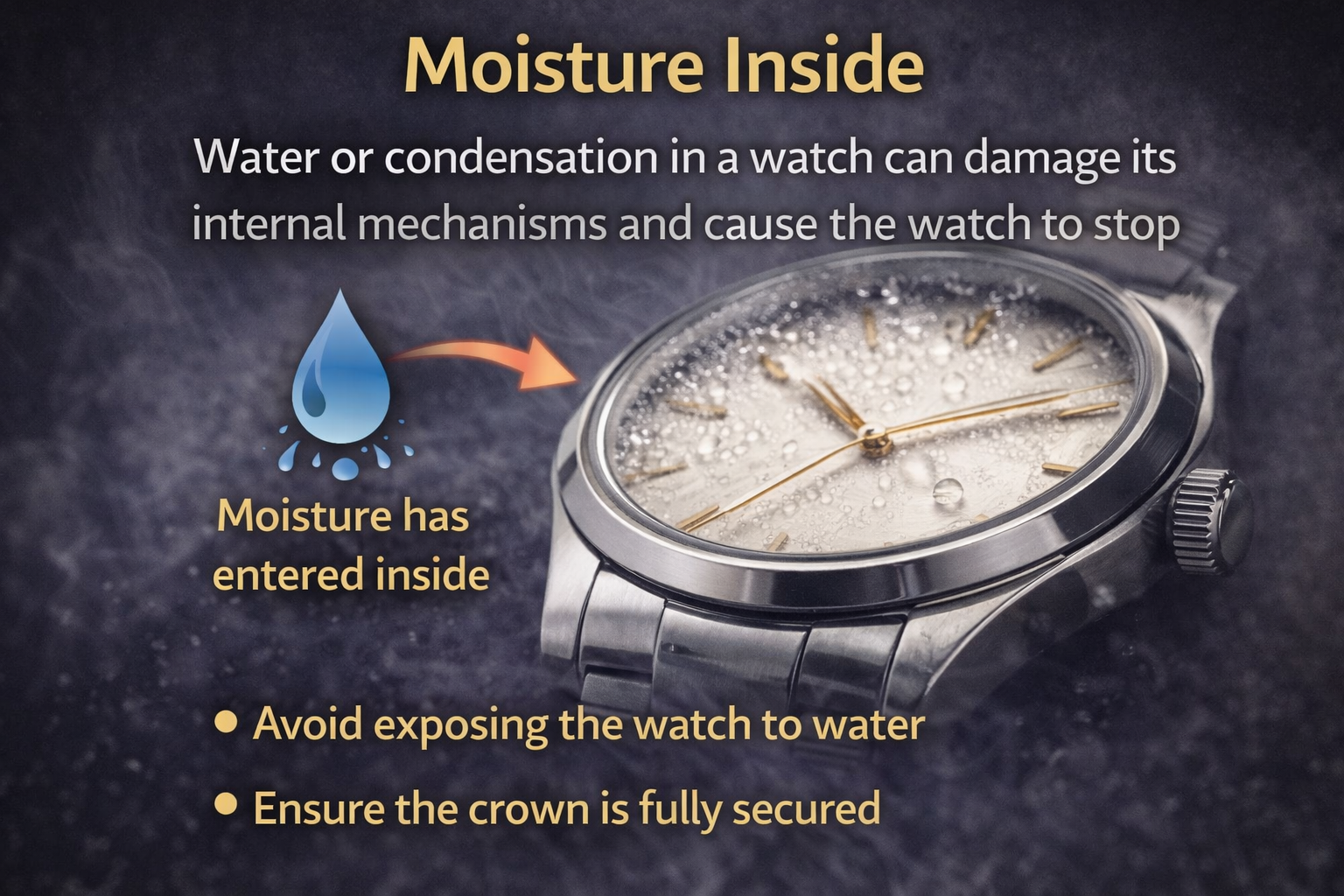
9. Moisture Has Gotten Inside
Moisture is one of the more serious possibilities.
Warning signs can include:
- fog under the crystal
- erratic stopping
- rust risk over time
- a watch that stops after shower or water exposure
Real Example
Someone showers with a “water-resistant” watch for months, then starts seeing fogging or performance issues. That is not a random coincidence.
If water habits are part of the story, can you wear a watch in the shower is highly relevant here, because moisture problems often begin with everyday habits people assume are harmless.
Could Magnetism Make a Watch Stop?
Magnetism is more often linked with timekeeping problems than total stopping, but in some cases it can absolutely make a watch behave strangely, especially a mechanical one.
A magnetized watch may:
- run too fast
- behave erratically
- seem unreliable
It is usually more associated with accuracy issues than a dead stop, but it is still worth considering if the watch has been near electronics, magnets, speakers, or magnetic closures.
What to Do If Your Watch Keeps Stopping
Here is the simplest real-world process.
Step 1: Identify the Watch Type
Is it quartz or automatic?
Step 2: Look for the Obvious Cause
Ask:
- has the battery been changed recently?
- has the watch been left unworn?
- is the crown fully pushed in?
- was it exposed to water?
- was it dropped?
Step 3: If It Is Quartz, Suspect the Battery First
That is usually the most likely answer.
Step 4: If It Is Automatic, Wind It Fully and Test It
Wind it manually if possible, then wear it properly and see whether it still stops too soon.
Step 5: Watch for Warning Signs
Be more cautious if you notice:
- fogging
- strange hand movement
- major time loss
- repeated stopping even after winding or battery replacement
Step 6: Stop Guessing If the Problem Repeats
If the watch keeps stopping after the obvious fixes, it may need service.
A Simple Test for Automatic Watches
If you own an automatic watch and are not sure whether it is a real problem, try this:
Practical Test
- Wind the watch fully
- Set the correct time
- Leave it alone
- See how long it keeps running
If it stops much earlier than it should, that may suggest:
- low reserve performance
- service need
- movement issue
If it runs normally after full winding, then the issue may simply be insufficient daily motion.
If you are wondering whether an automatic is really right for your routine, quartz vs automatic accuracy also helps because convenience and ownership style matter just as much as movement charm.
When a Stopping Watch Is Probably Normal
A watch stopping is often normal if:
- it is automatic and has been left unworn
- it was not wound enough
- the quartz battery is old
- the watch sat unused for a long time and just needs basic attention
In those cases, the issue may be annoying, but not serious.
When You Should Be More Concerned
Take it more seriously if:
- the watch stops repeatedly after a new battery
- the automatic watch still stops after proper winding
- you see condensation
- it was recently exposed to water or steam
- it was dropped
- the hands behave strangely
- timekeeping becomes wildly inaccurate
That is when it becomes more likely that the watch needs repair or service, not just a quick user fix.
Common Mistakes People Make
Mistake 1: Assuming Any Stopped Watch Is Broken
Sometimes it just needs power, winding, or a battery.
Mistake 2: Treating Automatic Watches Like Quartz
Automatics need a different ownership habit.
Mistake 3: Ignoring a Weak Battery Too Long
Letting a battery go too far can cause avoidable problems.
Mistake 4: Overlooking Moisture
A little fog under the crystal is never something to shrug off.
Mistake 5: Replacing the Battery Again and Again Without Checking the Movement
If the same problem keeps returning, the battery may not be the real issue.
Real-World Scenarios
Scenario 1: Quartz Watch Stops Every Few Days
Most likely cause: dying battery or movement fault.
Scenario 2: Automatic Watch Stops Overnight
Most likely cause: low power reserve or not enough daily movement.
Scenario 3: Watch Stops After Shower Exposure
Most likely cause: moisture risk or seal weakness.
Scenario 4: Watch Stops After Being Dropped
Most likely cause: internal damage or disrupted movement.
Scenario 5: Watch Only Stops When Left Unworn
Most likely cause: normal automatic behavior, not a defect.
These examples matter because the same symptom can come from very different causes.
Final Verdict
If you want the simplest answer, a watch that keeps stopping is not always broken, but it is always worth understanding.
For quartz watches, the battery is the first thing to suspect.
For automatic watches, low reserve and not enough wrist motion are usually the first places to look.
If the problem continues after those obvious checks, then the cause may be poor sealing, movement issues, impact damage, or a real need for service.
The smartest approach is simple:
- identify the watch type
- test the obvious cause first
- pay attention to warning signs
- do not ignore repeated stopping
That is how you separate a normal ownership issue from a real repair problem.
Key Takeaways
- quartz watches usually stop because of battery issues
- automatic watches usually stop because of low reserve or lack of motion
- a crown that is not fully in can also cause stopping
- water exposure and condensation are more serious warning signs
- a dropped watch may stop because of internal damage
- not every stopped watch is broken
- repeated stopping after basic fixes usually means the watch needs inspection
FAQ
Why does my watch stop and start again?
This often happens with a weak quartz battery or an automatic watch that is not getting enough power reserve.
Why does my automatic watch keep stopping at night?
The most common reason is that it did not build enough reserve during the day.
Why does my quartz watch keep stopping even after a battery change?
The replacement may have been poor, or the movement itself may have an issue.
Is it normal for an automatic watch to stop if I do not wear it?
Yes, that is normal once the stored energy runs out.
Should I repair a watch that keeps stopping?
If it keeps stopping after obvious fixes like winding or battery replacement, then yes, it is worth getting checked.
