
Best Watch Size for Large Wrists: How to Find the Right Fit Without Going Too Big
Best Watch Size for Large Wrists: How to Find the Right Fit Without Going Too Big
Quick Answer
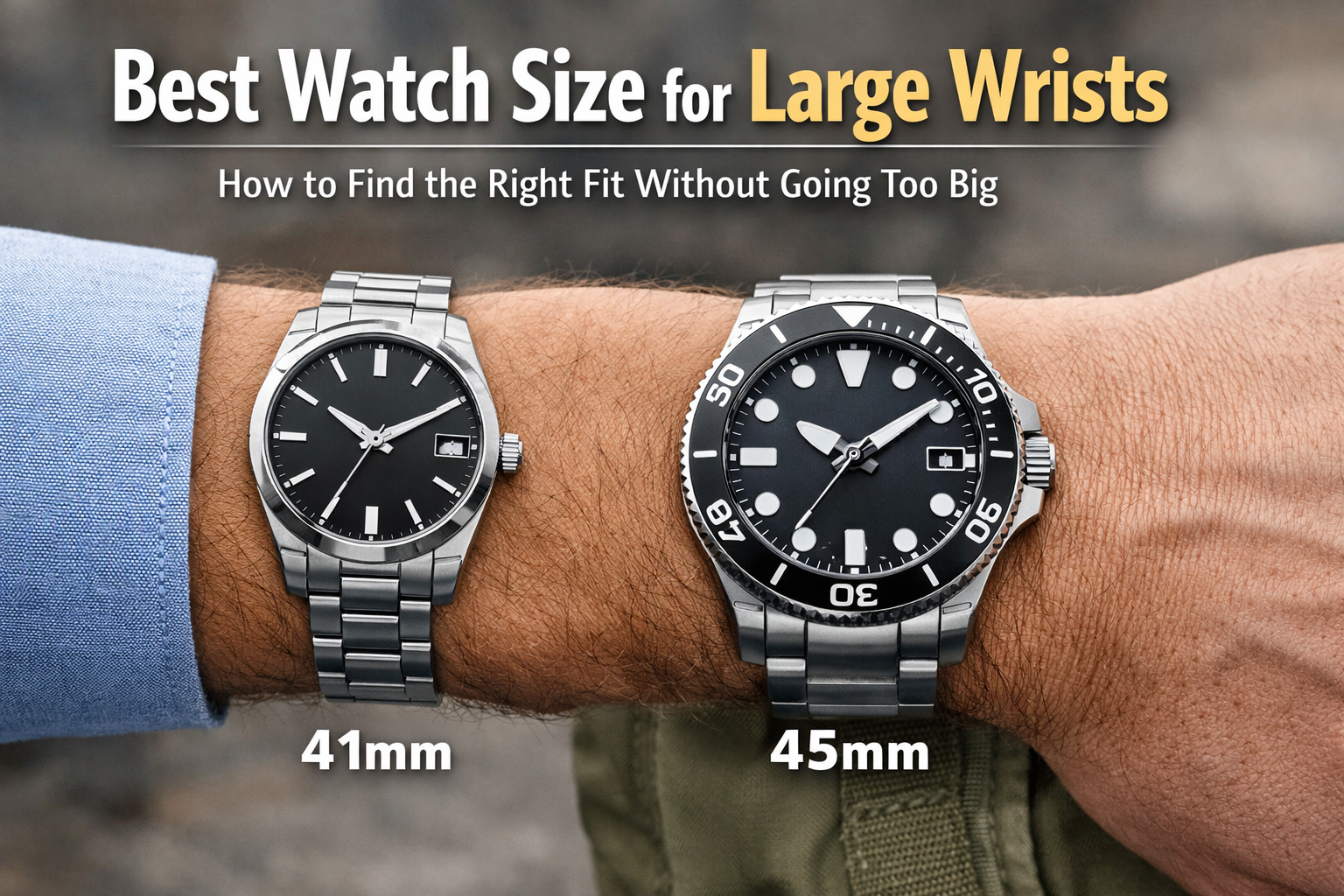
For most people with large wrists, the best watch size is usually 40mm to 44mm, with 41mm to 42mm often being the easiest all-around range for everyday wear. Some larger watches can work well too, but the biggest mistake large-wrist buyers make is assuming they should automatically buy the biggest case possible.
In real life, the best-looking watch on a large wrist is usually the one that looks balanced, not the one that looks oversized just because the wrist can technically handle it.
Why Large-Wrist Buyers Often Make the Opposite Mistake
People with small wrists often worry about buying a watch that is too big.
People with large wrists often make the opposite mistake: they assume they should always size up.
That sounds logical at first. If your wrist is bigger, surely a bigger watch is always the better choice. But that is not how watch fit works in real life.
A watch can be too small on a large wrist, but it can also be too thick, too long, too heavy, or just too visually aggressive. A balanced watch usually looks much better than one that feels like it is trying too hard.
Real Example
A buyer with a 7.75-inch wrist may think they need a 45mm sports watch. But once they try on a balanced 41mm or 42mm steel watch, they often realize it looks cleaner, wears more comfortably, and feels more versatile day to day.
If you have not measured your wrist yet, start with how to measure your wrist for the right watch size before comparing specific sizes.
What Counts as a Large Wrist?
In practical watch sizing, a large wrist is often around:
- 7.5 inches and above
- roughly 19 cm and above
That does not mean every large wrist should wear the same size range. It simply means you usually have more room to work with than average and can comfortably wear watches that feel too dominant on smaller wrists.
Best Watch Size Range for Large Wrists
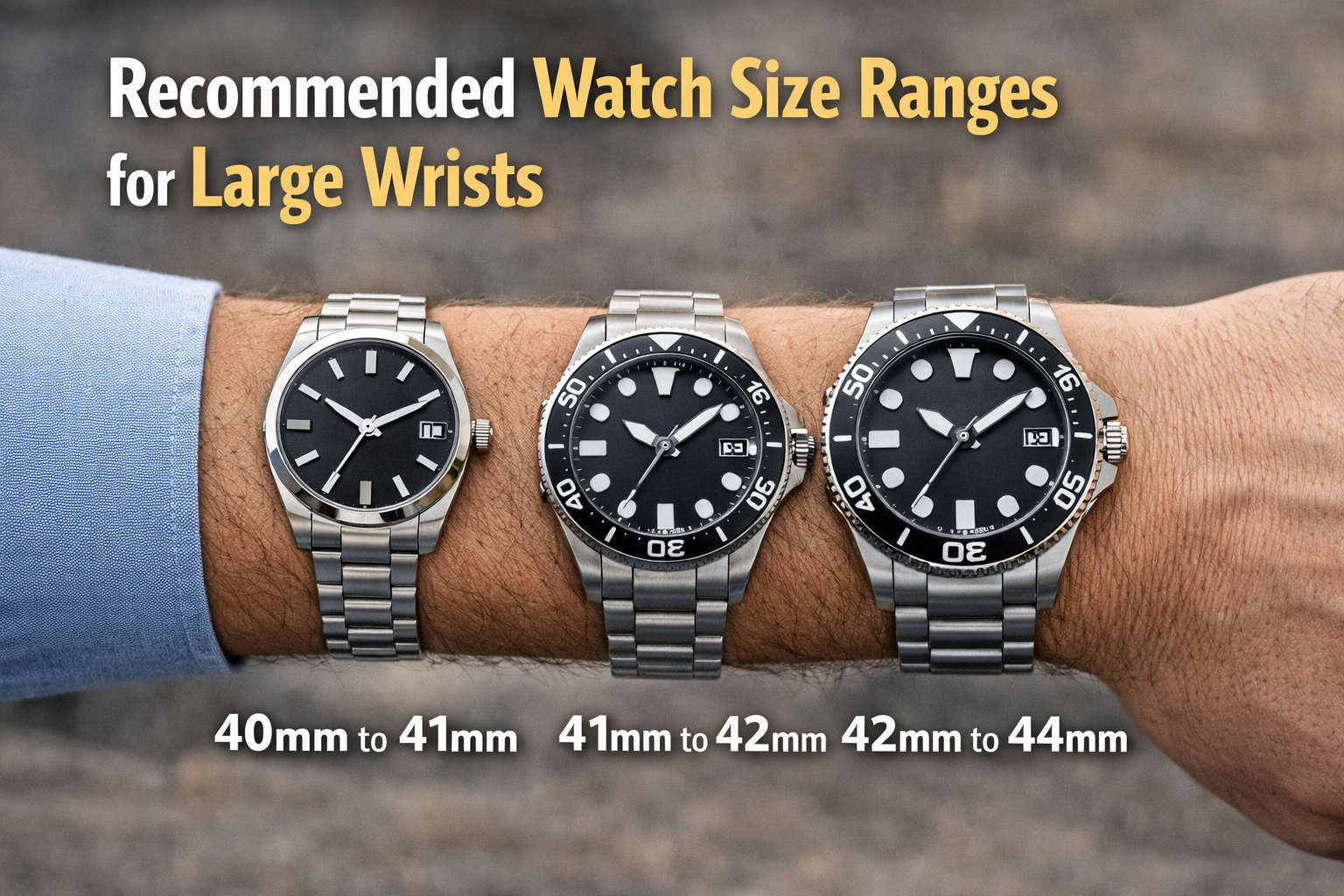
For most large wrists, these ranges work best:
40mm to 41mm
This range often feels surprisingly good for large wrists, especially if you want a more classic or balanced everyday look.
41mm to 42mm
For many buyers, this is the sweet spot. It gives enough wrist presence without feeling excessive, and it works across dress-casual, sport, and everyday styles.
42mm to 44mm
This range usually works very well for large wrists, especially if you like dive watches, sportier watches, or a stronger visual presence.
44mm and Above
This can work, but it becomes more style-specific. Some large wrists can carry it well, especially in dive or outdoor styles, but it is no longer automatically the best choice just because the wrist is large.
Why 41mm to 42mm Often Works Better Than Buyers Expect
A lot of large-wrist buyers imagine they need to start at 43mm or 44mm.
But in real life, 41mm to 42mm often gives the best overall balance.
Why? Because it usually offers:
- enough visual presence
- better comfort
- easier wear with different outfits
- less bulk
- better long-term versatility
Real-World Example
Imagine a buyer with a 7.8-inch wrist comparing these three watches:
- a 40mm everyday steel watch
- a 42mm dive-style watch
- a 45mm oversized sports watch
In many cases:
- the 40mm watch may look slightly restrained, but still elegant
- the 42mm watch feels balanced and strong
- the 45mm watch may feel fun at first, but less practical for everyday wear
That is why large wrists often benefit from moderation, not maximum size.
If you want a broader reference point, our guide on what size watch should you wear is a useful companion.
The 4 Things Large-Wrist Buyers Should Always Check
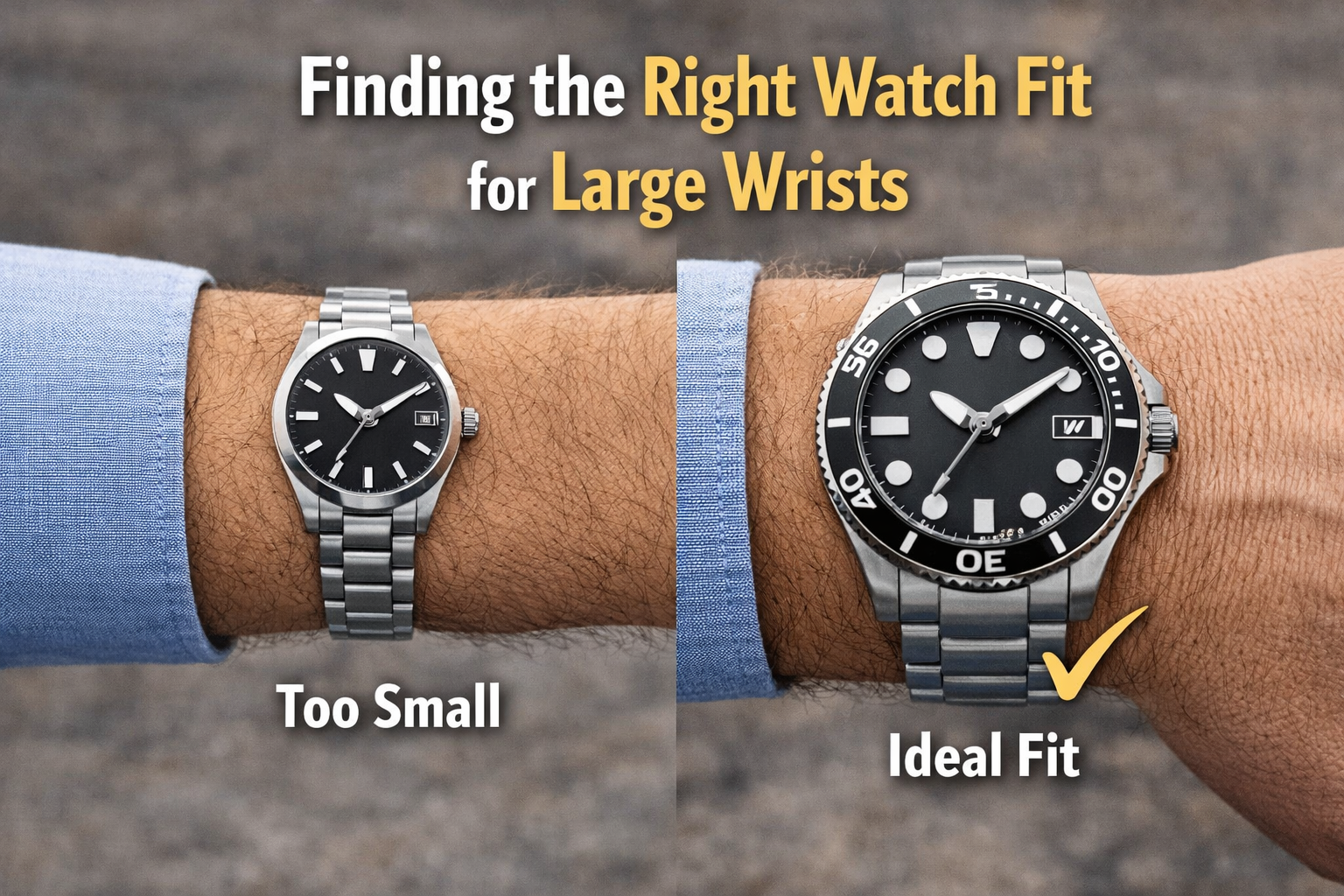
1. Case Diameter
Case diameter still matters, but large-wrist buyers should avoid treating it like the only number that matters.
A large wrist can usually wear:
- 40mm to 44mm very comfortably
- some 45mm+ watches depending on style
- smaller classic watches if the buyer prefers understated proportions
Practical Example
A 7.6-inch wrist may wear:
- a 40mm field watch in a classic, clean way
- a 42mm daily sports watch in a balanced way
- a 44mm dive watch in a bold but workable way
That does not mean 44mm is always better. It just means large wrists give you more options.
2. Lug-to-Lug Length
This is one of the most overlooked numbers for large wrists too.
A large wrist is more forgiving than a small one, but a very long lug-to-lug can still make a watch wear awkwardly, especially if the watch is flat and stretched out.
Real Example
Two 42mm watches may look similar online, but:
- Watch A has a 48mm lug-to-lug
- Watch B has a 52mm lug-to-lug
On a large wrist, both may fit. But Watch A may feel more controlled and versatile, while Watch B may feel more sprawling and less refined.
That is why lug-to-lug still matters even when your wrist size is generous.
If you want to understand fit more clearly, how to choose the right watch size for your wrist is worth reviewing alongside this article.
3. Case Thickness
Thickness changes everything.
A thin 41mm watch may feel sleek and elegant.
A thick 41mm dive watch may wear much larger than expected.
A thick 44mm watch can quickly become too much, even on a large wrist.
Real Example
A buyer with a large wrist may love the look of a 44mm sports watch on paper, but if it is very thick and heavy, it may become tiring during long daily wear.
This is where comfort becomes just as important as visual fit. If you want to think practically about wearability, our guide on how tight a watch should be can help you judge whether a watch will feel secure or cumbersome.
4. Strap or Bracelet Style
Strap choice can make a watch feel more compact, more rugged, more formal, or more substantial.
For large wrists:
- leather often makes a watch feel a bit more classic and controlled
- rubber can make it feel sporty and lighter
- metal bracelets add visual weight and structure
- NATO straps can make casual watches feel more tool-oriented
Real-World Example
A 42mm watch on leather may feel balanced and dress-casual.
The same watch on a thick steel bracelet may feel heavier and more dominant.
If this is part of your buying decision, best watch strap material for everyday wear can help you compare the tradeoffs more clearly.
Best Watch Styles for Large Wrists
Large wrists can carry a wide range of styles well, but some categories naturally work better.
Usually Great Choices
- dive watches
- field watches
- everyday steel sports watches
- larger chronographs
- tool watches
- robust casual watches
Styles That Need More Thought
- ultra-small minimalist watches
- very thin dress watches if you want strong wrist presence
- oversized novelty watches that prioritize size over balance
This is one reason large-wrist buyers often have more freedom. The challenge is not “what can I wear?” but rather “what looks best, not just biggest?”
If you are also thinking about long-term practicality, how to choose a durable watch for long-term use is useful here too.
What Usually Looks Best on a Large Wrist?
In most cases, the best-looking watch on a large wrist does these things:
- fills the wrist without looking exaggerated
- has enough presence to feel intentional
- does not look tiny or lost
- does not rely on bulk alone
- matches the wearer’s style and clothing
Practical Example
A 7.9-inch wrist wearing a balanced 42mm steel watch often looks natural and versatile.
The same wrist wearing a tiny 35mm minimalist watch may look too slight unless the wearer specifically wants a vintage or dressy look.
But the opposite is also true: a 46mm oversized sports watch may fit physically, yet still look less refined than a well-balanced 42mm model.
How to Tell If a Watch Is Too Small for a Large Wrist
A watch may feel too small if:
- it looks visually lost in the center of the wrist
- the strap or bracelet seems to overpower the case
- the dial feels too restrained for the style
- the watch disappears more than you want
Real Example
A 36mm everyday watch on a 7.75-inch wrist can still work in classic dress contexts, but for casual everyday wear many buyers would find it too small.
How to Tell If a Watch Is Too Big Even on a Large Wrist
Yes, this absolutely happens.
A watch may be too big if:
- it feels top-heavy all day
- the lugs stretch out too aggressively
- the case thickness makes it sit too high
- it dominates your whole wrist visually
- it becomes harder to wear with normal clothes
Real Example
A 45mm thick sports watch may technically fit a large wrist, but if you mostly wear smart-casual clothes, it can feel less versatile than a cleaner 41mm or 42mm option.
That is why “large wrist” should not automatically mean “largest watch available.”
Step-by-Step: How to Choose a Watch for a Large Wrist
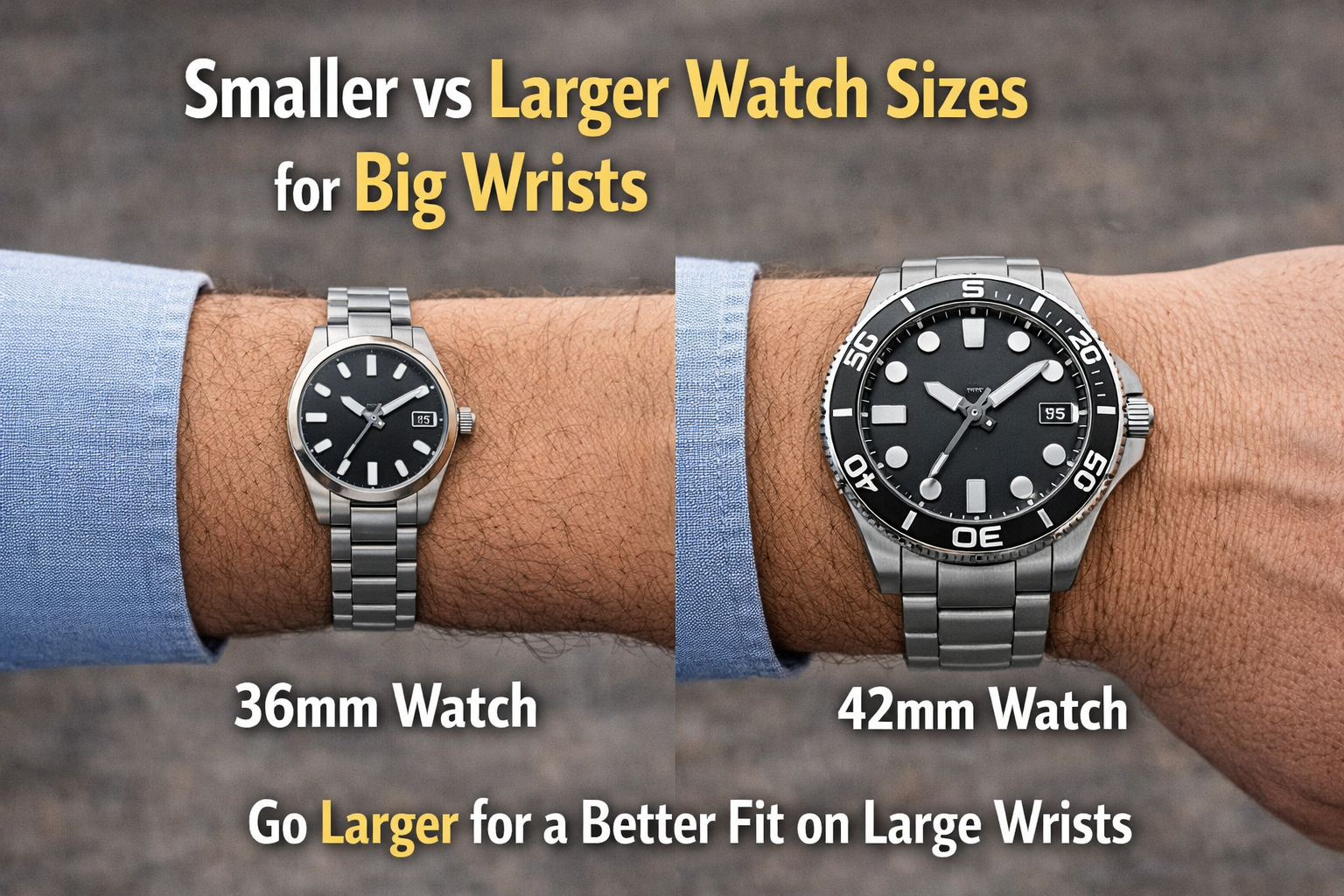
Here is the easiest real-world process.
Step 1: Measure Your Wrist
Do not assume. Know your actual size first.
Step 2: Start with 40mm to 44mm
This is the safest working range for most large wrists.
Step 3: Use 41mm to 42mm as Your Baseline
If you are unsure where to start, this range is usually the most versatile.
Step 4: Check Lug-to-Lug Before Buying
A big wrist helps, but a badly proportioned watch can still wear awkwardly.
Step 5: Think About Daily Use
Do you want:
- one balanced everyday watch
- a sporty casual watch
- a bold dive watch
- a dressier classic piece
Step 6: Check Thickness and Strap
A watch can look fine in diameter and still feel wrong because of thickness or bracelet weight.
Actual Buying Scenarios
Scenario 1: One Watch for Everything
If you have a 7.7-inch wrist and want one watch for most situations, a 41mm to 42mm steel everyday watch is often the smartest choice.
Scenario 2: You Like Sportier Watches
If you have a 7.9-inch wrist and prefer dive or outdoor styles, a 42mm to 44mm sports watch can often feel balanced without looking excessive.
Scenario 3: You Prefer More Classic Style
If you have a 7.6-inch wrist and like cleaner looks, a 40mm to 41mm dress-casual or field watch may actually look more refined than something bigger.
These examples matter because large wrists are not all the same. The best size depends on the look and use case, not just the measurement.
Common Mistakes Large-Wrist Buyers Make
Assuming Bigger Is Always Better
This is the most common mistake. Big wrists do not require oversized watches.
Ignoring Thickness
A watch can fit in width and still feel too bulky in real life.
Chasing Presence Instead of Balance
A strong watch should still feel wearable, not overwhelming.
Overlooking Smaller Classic Sizes
Some large-wrist buyers avoid 40mm too quickly, even though it may actually be the best-looking everyday size.
Buying for Wrist Size Alone
Style, use case, and clothing still matter just as much as measurements.
If you also care about the overall quality feel of a watch, what makes a high-quality watch is worth reading before you buy.
Should Large-Wrist Buyers Go Bigger or More Balanced?
That depends on what kind of look you want.
Go More Balanced If You Want:
- everyday versatility
- cleaner style
- easier wear with different outfits
- long-term comfort
Go Bigger If You Want:
- stronger sports presence
- bolder casual styling
- more dial visibility
- a more assertive wrist look
For most people, the smarter first choice is still the more balanced option.
Final Verdict
If you want the simplest answer, the best watch size for large wrists is usually 40mm to 44mm, with 41mm to 42mm being the most versatile range for everyday wear.
A large wrist gives you flexibility, but the goal is still balance. The best watch is rarely the biggest one. It is the one that fits your wrist naturally, matches your clothes, and feels good enough to wear often.
For most buyers, that means starting with a balanced 41mm or 42mm watch before jumping straight into oversized territory.
Key Takeaways
- most large wrists suit watches in the 40mm to 44mm range
- 41mm to 42mm is often the easiest all-around sweet spot
- large wrists do not automatically need oversized watches
- lug-to-lug and thickness still matter a lot
- dive watches, field watches, and everyday steel watches usually work very well
- a watch can be too small or too big even on a large wrist
- balance usually looks better than maximum size
FAQ
What is the best watch size for large wrists?
For most people with large wrists, the best range is usually 40mm to 44mm, with 41mm to 42mm often being the most versatile choice.
Is 44mm too big for a large wrist?
Not necessarily. A 44mm watch can work very well on a large wrist, especially in sporty styles, but thickness and lug-to-lug still matter.
Can a large wrist wear a 40mm watch?
Yes. In fact, many large-wrist buyers find that a 40mm or 41mm watch looks more balanced and versatile than something larger.
Can a watch still be too big on a large wrist?
Yes. A watch can feel too thick, too heavy, or too visually dominant even if the wrist is large enough to carry it.
What is the safest everyday watch size for a large wrist?
For many people, a 41mm or 42mm watch is the safest everyday choice because it balances presence, comfort, and versatility well.
